

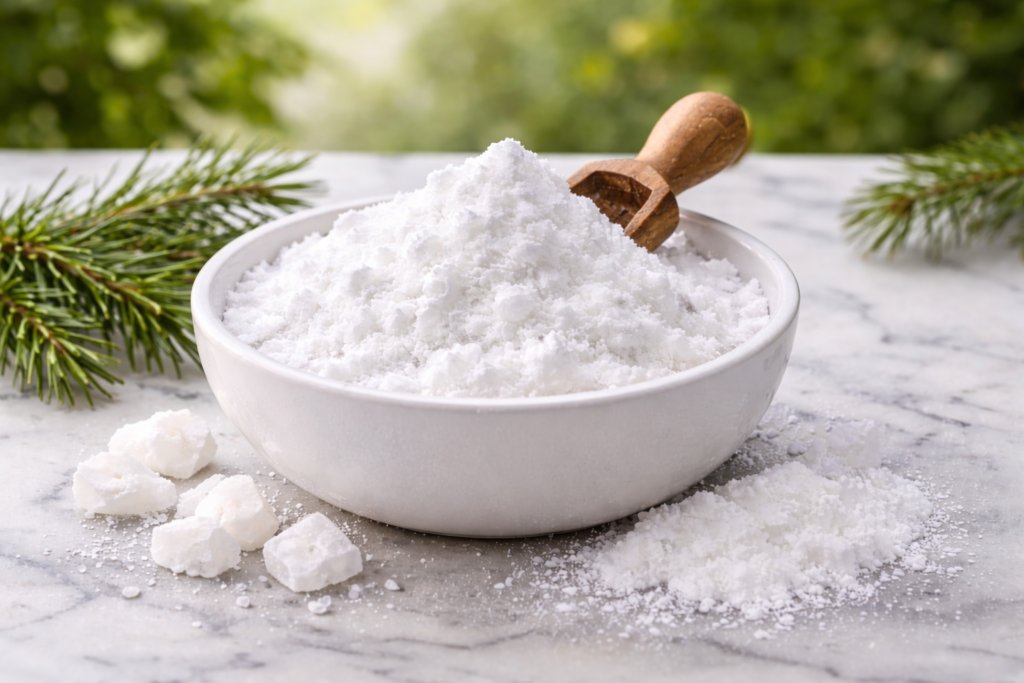
Isoborneol powder is a specialized bicyclic terpene alcohol that serves as a valuable intermediate in fragrance synthesis, pharmaceutical manufacturing, and specialty chemical production. While less widely known than its structural cousin borneol or the related compound camphor, isoborneol plays crucial roles in creating distinctive aromatic profiles and serving as a building block for complex chemical syntheses. At SVD PineChem, we recognize the growing demand for high-quality isoborneol as industries seek sustainable, naturally-derived chemical intermediates for advanced applications.
The specialty chemicals market in 2026 increasingly values compounds like isoborneol that bridge natural product chemistry with synthetic versatility. Isoborneol powder’s unique molecular structure and reactivity make it indispensable for fragrance houses, pharmaceutical developers, and chemical manufacturers who require precise molecular building blocks. At SVD PineChem, our expertise in terpene-derived specialty chemicals positions us to support customers navigating the technical and sourcing complexities of materials like isoborneol.
Understanding what isoborneol powder is, how it differs from related compounds, and where it finds application helps manufacturers, formulators, and researchers make informed decisions about incorporating this specialized material into their processes. This comprehensive guide explores the chemistry, properties, production methods, and applications of isoborneol powder to provide authoritative information for technical audiences.
What Is Isoborneol Powder and How Does It Differ from Borneol?
Isoborneol powder is a bicyclic monoterpene alcohol with the molecular formula C₁₀H₁₈O, appearing as white crystalline flakes or powder with a characteristic woody, camphoraceous aroma. Chemically, isoborneol is an isomer of borneol-they share the same molecular formula but differ in the spatial arrangement of their hydroxyl (-OH) group, making them stereoisomers. This structural difference, while subtle, creates distinct chemical and sensory properties.
The relationship between isoborneol, borneol, and camphor forms an interesting chemical family. Camphor (C₁₀H₁₆O) contains a ketone group, while both borneol and isoborneol contain a hydroxyl group-they are the reduced (alcohol) forms of camphor. Isoborneol specifically is the exo-isomer, meaning its hydroxyl group points away from the bicyclic ring system, whereas borneol is the endo-isomer with the hydroxyl group pointing toward the ring structure.
This stereochemical difference affects how isoborneol interacts with biological systems and other molecules. In fragrance applications, isoborneol contributes different aromatic nuances compared to borneol. The olfactory receptors in the human nose detect these subtle structural differences, resulting in distinct scent profiles. Similarly, in pharmaceutical applications, the stereochemistry can influence biological activity, receptor binding, and metabolic pathways.
Isoborneol powder typically comes from synthetic production routes rather than direct natural extraction, though it can be found in small quantities in some essential oils. The most common synthesis involves reducing camphor using specific catalysts and reaction conditions that favor formation of the exo-isomer. This synthetic accessibility makes isoborneol commercially available at reasonable costs for industrial applications.
How Is Isoborneol Powder Produced?
Isoborneol powder production primarily follows synthetic chemistry routes, with the most common method being the catalytic reduction of camphor. This process uses various reducing agents and catalysts to convert camphor’s ketone group to a hydroxyl group, yielding a mixture of borneol and isoborneol that can be separated or used as a mixture depending on application requirements.
The stereoselective synthesis of isoborneol requires careful control of reaction conditions. Using specific catalysts such as aluminum isopropoxide or certain metal hydride reagents can favor formation of the exo-isomer (isoborneol) over the endo-isomer (borneol). Temperature, solvent choice, and catalyst selection all influence the ratio of products obtained. Industrial producers optimize these parameters to maximize isoborneol yield while maintaining product purity.
Alternative production methods include biotechnological approaches using engineered microorganisms or enzyme systems to perform stereoselective transformations. These biocatalytic routes align with green chemistry principles and offer potential advantages in selectivity and environmental impact. However, chemical synthesis remains the dominant commercial production method due to established processes, cost-effectiveness, and scalability.
Once synthesized, isoborneol undergoes purification through crystallization, distillation, or chromatographic techniques depending on required purity levels. Pharmaceutical and fragrance applications typically demand high purity (95-99%), while some industrial uses may accept lower grades. At SVD PineChem, we work with producers employing rigorous quality control to ensure isoborneol powder meets application-specific requirements.
What Are the Key Chemical and Physical Properties?
Isoborneol powder exhibits several characteristic properties that define its behavior and applications. Understanding these properties helps manufacturers predict how isoborneol will perform in formulations and processes, ensuring optimal results in end-use applications.
Physical Characteristics: Isoborneol appears as white crystalline flakes or powder with a melting point around 212-214°C, slightly different from borneol’s melting point of approximately 208°C. This melting point difference provides one method for distinguishing between the isomers. The compound is solid at room temperature and exhibits the sublimation behavior typical of many bicyclic terpenes, though less pronounced than camphor.
Solubility Profile: Isoborneol powder shows limited solubility in water but dissolves readily in organic solvents including ethanol, ether, chloroform, and acetone. This solubility profile makes it suitable for incorporation into oil-based formulations, alcoholic solutions, and various organic synthesis reactions. The hydroxyl group contributes to its solubility characteristics and reactivity patterns.
Aromatic Properties: The scent of isoborneol is described as woody, camphoraceous, and slightly medicinal with earthy undertones. While similar to borneol’s aroma, trained perfumers can distinguish between the isomers’ subtle olfactory differences. This characteristic scent makes isoborneol valuable in creating complex fragrance compositions where specific aromatic notes are desired.
Chemical Reactivity: The secondary alcohol group in isoborneol participates in various chemical reactions including esterification, oxidation, and dehydration. These reactions enable its use as a chemical intermediate for synthesizing more complex molecules. The bicyclic structure provides rigidity that influences how the molecule interacts with catalysts and other reagents during chemical transformations.
Stability Considerations: Isoborneol powder is relatively stable under normal storage conditions but can oxidize over time when exposed to air, light, and heat. Proper storage in sealed containers away from oxidizing agents and extreme temperatures maintains product quality. The compound’s stability profile is adequate for most industrial handling and storage requirements when basic precautions are observed.
What Are the Primary Applications of Isoborneol Powder?
Fragrance Industry: Isoborneol powder serves as a fragrance ingredient and intermediate in perfumery, contributing woody, camphoraceous notes to fragrance compositions. Perfumers value it for adding depth and complexity to aromatic profiles, particularly in masculine fragrances, forest-themed scents, and compositions requiring herbal-medicinal notes. Beyond direct use, isoborneol serves as a starting material for synthesizing other fragrance compounds through chemical modification.
Pharmaceutical Intermediates: The pharmaceutical industry uses isoborneol powder as an intermediate in synthesizing various medicinal compounds. Its bicyclic structure and functional group provide a useful starting point for creating molecules with specific biological activities. While not typically a final active pharmaceutical ingredient itself, isoborneol contributes to the synthetic pathways of certain drugs and pharmaceutical research compounds.
Flavor Applications: In limited food and beverage applications, isoborneol may contribute to flavor profiles where camphoraceous or herbal notes are desired. Regulatory approval for food use varies by jurisdiction, and applications remain specialized compared to more common flavor compounds. When permitted, isoborneol helps create distinctive flavor experiences in specific product categories.
Chemical Synthesis: Isoborneol powder functions as a chiral building block in organic synthesis, particularly valuable when specific stereochemistry is required in target molecules. Its well-defined three-dimensional structure makes it useful in asymmetric synthesis and as a template for creating complex molecular architectures. Research laboratories and specialty chemical manufacturers utilize isoborneol in developing novel compounds.
Polymer Additives: Some polymer applications incorporate isoborneol or its derivatives as modifying agents to adjust physical properties such as glass transition temperature, flexibility, or processing characteristics. These specialized applications remain relatively niche but demonstrate the compound’s versatility beyond traditional fragrance and pharmaceutical uses.
Why Is Isoborneol Powder Important in 2026?
Isoborneol powder’s relevance in 2026 reflects several converging trends in specialty chemicals, sustainable sourcing, and advanced manufacturing. While not a commodity chemical, its strategic importance in specific applications continues to drive steady demand and ongoing research interest.
Natural Product Chemistry Renaissance: The industry-wide shift toward natural and naturally-derived ingredients has elevated interest in terpene-derived compounds like isoborneol. Even when synthetically produced, its structural relationship to natural products makes it attractive for formulations seeking natural-ingredient positioning. This trend particularly influences fragrance and personal care applications where consumer preferences drive ingredient selection.
Green Chemistry Initiatives: Isoborneol’s production from renewable terpene feedstocks (camphor from turpentine oil) aligns with sustainability goals and green chemistry principles. As companies work to reduce petroleum dependence and carbon footprints, bio-based chemical intermediates become increasingly strategic. The development of improved synthetic routes with better atom economy and reduced waste generation continues to enhance isoborneol’s environmental profile.
Specialty Fragrance Market Growth: The expanding premium and niche fragrance market drives demand for specialized aromatic compounds that create distinctive scent profiles. Isoborneol’s unique woody-camphoraceous character contributes to artisan and luxury fragrances where complexity and originality are valued. This market segment shows strong growth in 2026 as consumers seek personalized, sophisticated fragrance experiences.
Pharmaceutical Innovation: Ongoing drug discovery efforts continue exploring terpene-derived scaffolds for new therapeutic compounds. Isoborneol’s specific stereochemistry and functional groups make it valuable in medicinal chemistry research. While individual research applications may be small-scale, collectively they sustain demand and drive innovation in isoborneol chemistry.
How Does Isoborneol Compare to Related Compounds?
Understanding how isoborneol powder relates to similar compounds helps clarify its unique position in the chemical landscape and guides appropriate application selection. Several structurally related compounds share chemical family membership with isoborneol, each offering distinct properties.
Borneol vs. Isoborneol: These stereoisomers differ only in their hydroxyl group orientation, yet this creates measurable differences in properties and applications. Borneol (endo-isomer) appears more frequently in nature, particularly in essential oils from various plants. It has more established use in traditional medicine, especially in Asian pharmacopeias. Isoborneol (exo-isomer) is primarily synthetic and finds greater use in fragrance chemistry and as a chemical intermediate where its specific stereochemistry offers advantages.
Camphor Relationship: Camphor, the oxidized form containing a ketone group instead of a hydroxyl group, is far more widely known and used. Camphor’s distinct properties-including greater volatility and different biological activities-make it suited to different applications than isoborneol. The ability to interconvert between camphor, borneol, and isoborneol through reduction and oxidation reactions makes them a versatile chemical family for synthetic transformations.
Fenchol and Other Terpene Alcohols: Other bicyclic terpene alcohols like fenchol share structural similarities with isoborneol but have different ring fusion patterns and properties. Each contributes unique aromatic characteristics to fragrance compositions. Formulators select among these related compounds based on desired scent profiles, cost considerations, and availability.
Synthetic vs. Natural Sourcing: While isoborneol can be found in trace amounts in some essential oils, commercial material is predominantly synthetic. This contrasts with borneol, which is commonly extracted from natural sources. The synthetic origin doesn’t diminish isoborneol’s value but affects its positioning in natural vs. synthetic ingredient categories for regulatory and marketing purposes.
What Quality Factors Should You Consider When Sourcing?
Purity and Isomeric Composition: Isoborneol powder quality depends significantly on purity level and the ratio of isoborneol to borneol if sold as a mixture. High-purity isoborneol (95-99%) commands premium prices but is essential for applications requiring specific stereochemistry. Some applications can use borneol/isoborneol mixtures at lower cost. Certificates of analysis should clearly specify isomeric composition and overall purity.
Residual Impurities: Synthetic production can leave trace impurities including unreacted camphor, by-products from reduction reactions, or catalyst residues. Stringent purification removes these impurities to levels acceptable for intended applications. Pharmaceutical and fragrance uses require particularly low impurity levels, while some industrial applications tolerate higher impurity content.
Optical Activity: For applications where chirality matters, verifying optical activity through polarimetry provides additional quality assurance. Pure isoborneol exhibits specific optical rotation that confirms stereochemical purity. This parameter becomes critical in pharmaceutical intermediates or research applications requiring defined chirality.
Stability and Packaging: Proper packaging in moisture-resistant, sealed containers protects isoborneol powder from environmental degradation. Quality suppliers provide packaging suitable for the intended storage duration and handling requirements. Material safety data sheets should specify recommended storage conditions and expected shelf life under proper storage.
Regulatory Compliance: Depending on intended use, isoborneol may require specific regulatory compliance documentation. Fragrance applications need IFRA (International Fragrance Association) compliance verification, food applications require food-grade certification, and pharmaceutical uses demand GMP manufacturing and appropriate testing. At SVD PineChem, we ensure our isoborneol powder meets relevant regulatory standards for customer applications.
What Are the Handling and Safety Considerations?
Isoborneol powder requires appropriate handling practices to ensure worker safety and maintain product quality. While generally considered safer than many industrial chemicals, understanding its hazard profile and implementing proper controls protects personnel and processes.
Physical Hazards: As a combustible solid, isoborneol powder presents fire hazards under certain conditions. Avoid generating dust clouds, keep away from ignition sources, and store away from strong oxidizing agents. Facility ventilation should be adequate to prevent dust accumulation, and grounding/bonding procedures should be followed during transfer operations.
Health Considerations: Direct contact with isoborneol powder may cause mild skin or eye irritation in some individuals. Inhalation of dust should be minimized through engineering controls and, when necessary, respiratory protection. While not highly toxic, prudent industrial hygiene practices including use of gloves, safety glasses, and dust masks in dusty environments protect workers from potential exposures.
Environmental Precautions: Prevent isoborneol powder from entering waterways or soil through appropriate containment during storage and handling. While biodegradable, concentrated releases could impact aquatic organisms. Follow local environmental regulations for storage, use, and disposal of chemical materials.
Storage Requirements: Store isoborneol powder in cool, dry, well-ventilated areas away from incompatible materials (strong oxidizers, strong acids or bases). Keep containers tightly closed when not in use to prevent moisture absorption and quality degradation. Implement appropriate inventory management to use material within its recommended shelf life.
Emergency Response: In case of spills, contain material using appropriate methods, avoiding dust generation during cleanup. For personnel exposure, follow standard first aid procedures-flush affected skin or eyes with water, move to fresh air if inhaled, and seek medical attention if symptoms persist. Maintain material safety data sheets readily accessible for emergency responders.
What Does Current Research Say About Isoborneol?
Scientific research on isoborneol powder continues to explore its chemical properties, synthesis methods, and potential applications, contributing to ongoing understanding of this specialized compound. While not as extensively studied as more common terpenes, focused research efforts yield valuable insights.
Recent synthetic chemistry research has developed improved methods for stereoselective isoborneol production with better yields and atom economy. These advances reduce waste generation and production costs, making isoborneol more commercially attractive. Publications in organic chemistry journals document novel catalytic systems and reaction conditions optimized for isoborneol synthesis.
Fragrance chemistry research examines how subtle stereochemical differences between borneol and isoborneol translate to olfactory perception differences. Understanding structure-odor relationships helps perfumers make informed choices when formulating complex fragrances. This research combines analytical chemistry, sensory science, and molecular modeling to decode aroma properties at the molecular level.
Biological activity studies investigate potential applications for isoborneol and its derivatives in pharmaceutical development. While research remains preliminary, some studies suggest interesting biological properties worthy of further investigation. These research efforts contribute to the broader exploration of terpene-derived molecules in medicinal chemistry.
Green chemistry research explores biotechnological production routes for isoborneol using engineered microorganisms or isolated enzyme systems. These approaches could offer more sustainable production methods in the future, though current commercial production remains predominantly chemical synthesis. Continued research may eventually shift production paradigms toward biological routes.
Conclusion: Isoborneol Powder as a Specialized Chemical Building Block
Isoborneol powder occupies a specialized niche in the chemical landscape, serving critical roles in fragrance synthesis, pharmaceutical intermediates, and specialty chemical applications where its unique stereochemistry and properties provide distinct advantages. While not a high-volume commodity, its strategic importance in specific applications sustains steady demand and ongoing innovation.
Understanding isoborneol’s chemistry, properties, production methods, and applications enables informed decision-making for manufacturers and formulators considering this compound. The technical complexity of stereoisomers and specialized applications requires working with knowledgeable suppliers who understand both the chemistry and the market dynamics of specialty terpene derivatives.
At SVD PineChem, we bring deep expertise in terpene-derived specialty chemicals including isoborneol powder, supporting customers with technical knowledge, quality products, and reliable supply chain management. Whether you’re developing novel fragrances, synthesizing pharmaceutical intermediates, or exploring innovative chemical applications, accessing high-quality isoborneol with appropriate documentation and support makes a meaningful difference in project success.
The specialty chemicals sector in 2026 increasingly values compounds that combine natural product heritage with synthetic accessibility and versatile chemistry. Isoborneol exemplifies this convergence-a naturally-inspired molecule readily produced through sustainable chemistry, offering unique properties for demanding applications. As industries continue seeking sophisticated chemical building blocks that align with sustainability goals while delivering performance, compounds like isoborneol will maintain their important, if specialized, roles in advanced chemical manufacturing.
Frequently Asked Questions (FAQ)
Q: What is the main difference between isoborneol and borneol?
A: Isoborneol and borneol are stereoisomers-they have the same molecular formula (C₁₀H₁₈O) but differ in the spatial orientation of their hydroxyl group. Isoborneol is the exo-isomer with the -OH group pointing away from the bicyclic ring system, while borneol is the endo-isomer with the -OH group pointing toward the ring. This structural difference creates distinct chemical reactivity, physical properties, and aromatic characteristics between the two compounds.
Q: Is isoborneol naturally occurring or synthetic?
A: While isoborneol can be found in trace amounts in some essential oils, commercial isoborneol powder is predominantly synthetic, produced through catalytic reduction of camphor. The synthetic route provides consistent quality, reliable supply, and cost-effectiveness compared to extraction from natural sources. Even though synthetically produced, isoborneol has the identical molecular structure to naturally occurring material.
Q: What industries primarily use isoborneol powder?
A: The fragrance industry is the primary consumer of isoborneol powder, using it as a fragrance ingredient and intermediate for creating woody, camphoraceous notes. The pharmaceutical industry uses it as a chemical intermediate in drug synthesis. Specialty chemical manufacturers employ it as a chiral building block in organic synthesis. Additional niche applications include flavor chemistry and polymer modification.
Q: How should isoborneol powder be stored?
A: Store isoborneol powder in tightly sealed containers in a cool, dry, well-ventilated area away from heat sources, direct sunlight, and incompatible materials like strong oxidizers. Proper storage prevents moisture absorption, oxidative degradation, and quality loss. Under appropriate storage conditions, isoborneol maintains quality for extended periods, though specific shelf life should be confirmed with suppliers.
Q: Can isoborneol be used in food products?
A: Isoborneol’s use in food products is limited and subject to regulatory approval in specific jurisdictions. Its applications in flavor chemistry are specialized and must comply with local food safety regulations. Most isoborneol applications focus on fragrances, pharmaceuticals, and industrial chemistry rather than food use. Always verify regulatory status for intended applications in your region.
Q: What is the typical purity level for commercial isoborneol powder?
A: Commercial isoborneol powder typically ranges from 95-99% purity depending on application requirements and manufacturing processes. High-purity grades (98-99%) suit pharmaceutical and fragrance applications requiring minimal impurities, while industrial chemistry applications may use lower grades. Suppliers should provide certificates of analysis specifying purity, isomeric composition, and relevant quality parameters for each lot.
