

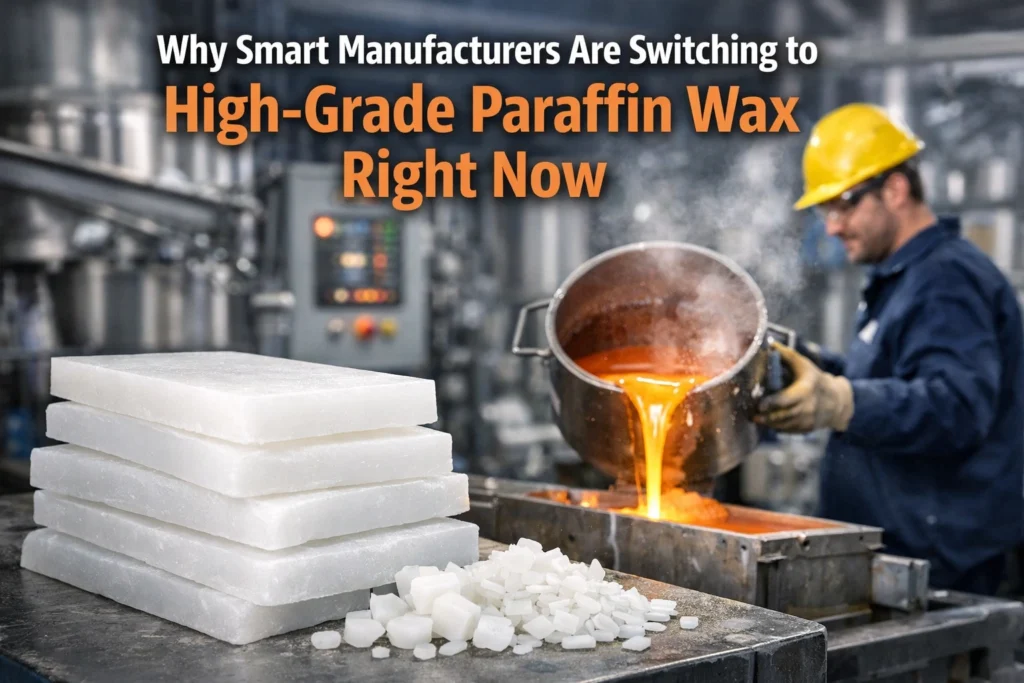
Paraffin Wax has quietly become one of the most strategically important raw materials in India’s industrial chemical sector in 2026. Once considered a commodity with limited differentiation, high-grade paraffin wax is now at the centre of a significant manufacturing shift — driven by tighter quality standards, rising export ambitions, and the accelerating demand for performance-grade inputs across adhesives, coatings, food packaging, textiles, and rubber processing industries.
Paraffin Wax demand in India is projected to grow at a CAGR of 4.8% through 2028, driven by expanding downstream industries including packaging, candles, cosmetics, and specialty coatings (Statista Global Wax Market Report, 2025–26). As a result, procurement teams and production managers across India are actively re-evaluating their raw material suppliers — prioritising quality, consistency, and technical support over pure cost considerations.
Paraffin Wax sourcing decisions are no longer made in isolation from broader formulation strategy. At SVD PineChem — India’s trusted manufacturer and distributor of pine-based specialty chemicals — we work closely with manufacturers, industrial clients, and exporters to ensure that every batch of paraffin wax delivered meets the precise technical specifications that modern production lines demand. This article explores why the switch to high-grade paraffin wax is happening now, and what it means for your manufacturing operation.
What Is Driving the Shift to High-Grade Paraffin Wax in Indian Manufacturing in 2026?
Paraffin Wax quality grading has become a decisive factor as India’s manufacturing sector integrates into higher-value global supply chains. The government’s Production Linked Incentive (PLI) schemes across chemicals, pharmaceuticals, and specialty materials have pushed Indian manufacturers to upgrade raw material standards to meet international buyer requirements. Low-grade or inconsistently refined paraffin wax simply cannot meet the technical tolerances that global OEM contracts now require.
Paraffin Wax applications across Indian industries have also diversified significantly. What was once primarily a candle and polish ingredient now serves as a critical functional input across:
- Hot-melt adhesive formulations used in packaging, bookbinding, and product assembly lines.
- Rubber and tyre manufacturing, where paraffin wax acts as an anti-ozonant surface protectant extending product lifespan.
- Food-grade coatings for fresh produce, dairy packaging, and confectionery wrapping compliant with FSSAI and FDA standards.
- Textile sizing and finishing processes in mills across Gujarat, Tamil Nadu, and Maharashtra.
- Construction materials including waterproofing compounds, wood treatment formulations, and anti-corrosion coatings.
- Cosmetics and personal care — a sector growing at 9.2% annually in India (IBEF, 2026) — where refined paraffin wax is a key emollient base.
How Does High-Grade Paraffin Wax Differ From Standard Industrial Grades?
Paraffin Wax grading is primarily determined by oil content, melting point, colour, and the degree of refinement. The difference between commodity-grade and high-grade paraffin wax is not merely cosmetic — it has direct, measurable consequences on end-product performance, shelf life, and regulatory compliance.
What Are the Key Technical Specifications That Define High-Grade Paraffin Wax?
Paraffin Wax at high-grade specification typically meets the following benchmarks:
- Oil content below 0.5%: Fully refined grades contain minimal residual oil, making them suitable for food contact, pharmaceutical, and cosmetic applications.
- Melting point range of 58°C–72°C: Precision-controlled melting points ensure consistent performance in hot-melt adhesives, coatings, and candle formulations across varying ambient temperatures.
- Colour specification of +25 Saybolt or better: High-grade paraffin wax is water-white or near-white in appearance, critical for cosmetic and food packaging applications where colour contamination is unacceptable.
- Low aromatic content: Fully refined paraffin wax with low aromatic hydrocarbon content meets EU and US FDA food-contact material regulations — essential for exporters targeting European and North American markets.
- Consistent needle penetration values: Hardness consistency across batches ensures predictable processing behaviour on high-speed manufacturing lines.
Paraffin Wax sourced from inconsistent or under-refined suppliers often leads to batch rejection, product recalls, and compliance failures — all of which carry reputational and financial consequences far greater than any saving made on raw material procurement. According to SVD PineChem’s 2026 India market insights, over 40% of quality rejection incidents reported by Indian adhesive and coatings manufacturers are traceable to raw material variability — particularly wax and resin inputs.
Why Are Pine-Based Chemical Manufacturers Uniquely Positioned to Supply High-Grade Paraffin Wax?
Paraffin Wax is frequently used in combination with pine-derived chemical compounds such as rosin, terpene resins, and tall oil fatty acids in adhesive and coating formulations. This creates a natural synergy between high-grade paraffin wax supply and pine chemistry expertise — a combination that defines SVD PineChem’s value proposition in the Indian specialty chemicals market.
Paraffin Wax blended with rosin-derived tackifiers is the formulation backbone of many pressure-sensitive adhesives (PSAs) used in tapes, labels, and flexible packaging across India’s rapidly growing e-commerce and FMCG sectors. India’s packaging industry alone is projected to reach a market value of USD 204 billion by 2027 (India Brand Equity Foundation, 2026), creating enormous downstream demand for well-specified wax-resin blends.
At SVD PineChem, we specialise in the supply of high-grade paraffin wax alongside our full range of pine-based chemicals — including gum rosin, rosin esters, terpene resins, and distilled tall oil — enabling our clients to source complementary raw materials from a single, quality-assured supplier. This integrated approach reduces procurement complexity, ensures chemical compatibility between inputs, and accelerates formulation development for our manufacturing partners.
Paraffin Wax supply chain reliability is another critical advantage. India’s specialty chemical import dependency for certain wax grades has historically created supply volatility, particularly during global crude oil market disruptions. SVD PineChem’s domestic sourcing network and established refinery partnerships ensure that our clients maintain consistent supply continuity regardless of global commodity market fluctuations.
What Industries in India Benefit Most from Switching to High-Grade Paraffin Wax?
Paraffin Wax upgrades deliver measurable performance improvements across multiple Indian industries in 2026. The benefits are not theoretical — they are documented in formulation performance data, regulatory audit outcomes, and export market access achievements.
How Is High-Grade Paraffin Wax Transforming Indian Adhesive and Coating Manufacturers?
Paraffin Wax plays a dual role in hot-melt adhesive systems — as a viscosity modifier and as a crystallisation controller that determines the adhesive’s open time, set speed, and temperature resistance. Manufacturers using high-grade, narrow-melting-point paraffin wax report significantly improved adhesive consistency, reduced pot-life variability, and better performance in automated application systems.
Paraffin Wax quality matters equally in the following sectors:
- Rubber and tyre manufacturing: India is the world’s third-largest rubber producer, and its tyre sector — led by companies in Chennai, Pune, and Vadodara — relies on anti-ozonant paraffin wax grades with highly controlled molecular weight distribution to protect vulcanised rubber surfaces effectively.
- Food packaging and agriculture: Post-harvest fruit and vegetable coatings using food-grade paraffin wax reduce moisture loss and extend shelf life by up to 30%, directly supporting India’s USD 50 billion food processing industry (Ministry of Food Processing Industries, 2026).
- Textiles and technical fabrics: Wax sizing agents in weaving mills require precise melt-flow behaviour and low tackiness at room temperature — properties only consistently delivered by fully refined, high-grade paraffin wax.
- Board and paper lamination: India’s corrugated board and paper packaging sector uses paraffin wax coatings for moisture and grease resistance, with growing export demand for food-safe laminated board from Gulf and Southeast Asian markets.
- Candle manufacturing for export: India is a significant candle exporter, and international buyers — particularly in the EU — increasingly mandate low-oil, fully refined paraffin wax with documented chain-of-custody certification.
What Should Indian Manufacturers Look for When Sourcing High-Grade Paraffin Wax?
Paraffin Wax procurement decisions involve far more than selecting a product grade from a catalogue. In 2026, Indian manufacturers operating at the quality frontier are evaluating paraffin wax suppliers on a comprehensive set of criteria that reflects both domestic regulatory requirements and international export standards.
- Batch-level Certificate of Analysis (CoA): Every delivery should be accompanied by a full technical data sheet confirming oil content, melting point, needle penetration, colour, and flash point — tested against BIS, ASTM, or ISO standards.
- Regulatory compliance documentation: For food-contact, pharmaceutical, or cosmetic applications, suppliers must provide compliance statements against FSSAI regulations, EU Regulation 10/2011 (plastic food contact materials), or USP/BP pharmacopoeia standards as applicable.
- Consistent supply capacity: Bulk order fulfilment reliability — including lead times, minimum order quantities, and logistics capability across Indian states — is essential for production planning.
- Technical application support: High-grade wax suppliers should offer formulation guidance, application troubleshooting, and compatibility advice — not just product delivery.
- Traceability and sustainability credentials: Increasingly, global buyers are requiring upstream traceability of raw materials and carbon footprint documentation from Indian exporters. Suppliers with documented sourcing practices and environmental compliance are becoming a procurement requirement, not just a preference.
SVD PineChem’s premium pine-based chemicals and paraffin wax supply meet all of the above criteria. Our quality management processes, supplier audit framework, and technical team ensure that every product leaving our facility is backed by full documentation, consistent specifications, and the formulation expertise our clients need to succeed in demanding domestic and international markets.
Conclusion: The Upgrade to High-Grade Paraffin Wax Is a Competitive Necessity
Paraffin Wax grade selection has moved from a back-of-house procurement detail to a front-line competitive differentiator in 2026. As Indian manufacturers pursue higher-value contracts, international export approvals, and tighter quality certifications, the quality of every raw material input — including paraffin wax — directly determines whether they qualify for or fail to reach the next tier of the global supply chain.
Paraffin Wax is not a commodity to be sourced purely on lowest available supply. It is a performance input whose grade, consistency, and compliance documentation can make or break product quality, regulatory approval, and customer confidence — whether you are supplying an adhesive to an FMCG line in Ahmedabad or exporting coated packaging board to a buyer in Germany.
At SVD PineChem, we specialise in the supply of high-grade paraffin wax and a comprehensive range of pine-based specialty chemicals that help Indian manufacturers build better products, win better contracts, and compete more effectively in both domestic and global markets. Whether you are a mid-sized adhesive manufacturer in Pune, a tyre compounding specialist in Chennai, or a packaging exporter targeting EU compliance, SVD PineChem is your quality-assured raw material partner for 2026 and beyond.
FAQ: Paraffin Wax for Indian Manufacturers and Exporters
| Q1. What grades of paraffin wax are available for industrial use in India? Indian manufacturers can access fully refined paraffin wax (oil content below 0.5%), semi-refined paraffin wax (oil content 0.5%–2%), slack wax (a precursor to refined grades used in rubber and board industries), and microcrystalline wax (a higher-melting-point, more flexible variant used in cosmetics, pharmaceuticals, and specialty coatings). The appropriate grade depends entirely on the application, regulatory requirements, and performance specifications required. |
| Q2. How does paraffin wax interact with rosin and pine-based resins in adhesive formulations? In hot-melt and pressure-sensitive adhesive formulations, paraffin wax is typically used as a diluent and processing aid alongside rosin-derived tackifiers such as glycerol ester of rosin or hydrogenated rosin esters. Paraffin wax reduces melt viscosity for easier application, controls open time and set speed, and improves the adhesive’s release profile. The ratio of wax to resin is formulation-specific and requires compatibility testing for each application. |
| Q3. Can Indian manufacturers export paraffin wax blends and adhesive formulations containing paraffin wax? Yes. India is an active exporter of specialty adhesives, coatings, and wax-based formulations to markets in the Middle East, Southeast Asia, Africa, and Europe. Exporters must ensure compliance with the importing country’s chemical regulations — including REACH in the EU, GHS labelling requirements, and food-contact material standards where applicable. DGFT export documentation and HSN code classification for paraffin wax (HS Code 2712) must be accurately maintained. |
| Q4. What is the shelf life of high-grade paraffin wax under Indian storage conditions? Fully refined paraffin wax has an indefinite shelf life when stored correctly — in a cool, dry environment away from direct sunlight and heat sources above 40°C. In Indian summer conditions, storage facilities should ideally be temperature-controlled or at minimum well-ventilated. Wax stored in sealed, original packaging retains full specification compliance without degradation. Partially opened containers should be re-sealed to prevent dust and moisture contamination. |
| Q5. How is high-grade paraffin wax relevant to India’s sustainability and green chemistry goals? Fully refined paraffin wax, when used to replace petroleum-derived synthetic coatings and solvent-based adhesive components, can reduce VOC emissions and improve recyclability of coated paper and board products. In combination with bio-based pine chemistry inputs such as rosin and terpene resins, paraffin wax can contribute to partially bio-based adhesive and coating formulations aligned with India’s green chemistry and circular economy objectives under the National Chemical Policy framework. |
| Q6. What certifications should a paraffin wax supplier in India hold? For domestic supply, look for ISO 9001:2015 quality management certification and BIS compliance for relevant product standards. For food-grade supply, FSSAI registration and FDA compliance documentation are essential. For pharmaceutical-grade wax, USP or BP pharmacopoeia compliance is required. Exporters supplying EU markets should seek REACH-registered suppliers and ensure product safety data sheets (SDS) are compliant with GHS/CLP Regulation formatting standards. |
