

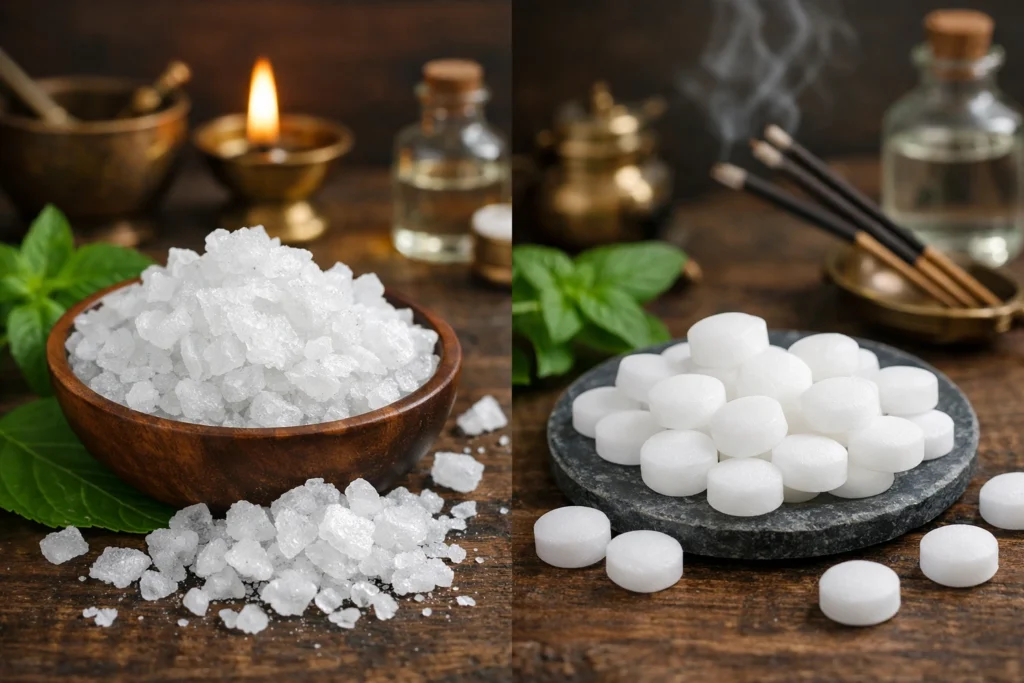
Bhimseni Camphor Flakes have carved out a distinct and highly valued place in India’s chemical, pharmaceutical, and ritual goods markets — yet the choice between Bhimseni camphor and regular synthetic camphor continues to confuse buyers at every level, from small agarbatti manufacturers in Ahmedabad to large pharmaceutical exporters in Hyderabad. With India’s specialty chemicals sector forecast to surpass USD 64 billion in 2026 (Indian Chemical Council, 2026) and global demand for natural ingredients growing at an accelerating pace, making the right camphor procurement decision has never been more commercially important.
Bhimseni Camphor Flakes sourced from a trusted, quality-verified supplier can be the difference between a formulation that meets international pharmacopoeia standards and one that does not. As India’s dedicated premium Bhimseni camphor flakes manufacturer and supplier, SVD PineChem works daily with pharmaceutical companies, incense manufacturers, fragrance houses, and chemical distributors to help them source the exact grade of camphor their application demands — with full documentation, consistent purity, and competitive bulk pricing.
Bhimseni Camphor Flakes vs regular camphor is not just a question of tradition versus modernity. It is a technical, regulatory, and financial decision that deserves a clear, expert-backed answer. This guide provides exactly that — with 2026 market data, realistic pricing benchmarks, and application-specific guidance tailored to the Indian market and global export context.
What Is Bhimseni Camphor and Where Does It Come From?
Bhimseni Camphor Flakes are derived from the heartwood and resin of Dryobalanops aromatica, a tree native to Southeast Asia, through a natural steam or dry distillation process that preserves the compound’s full aromatic and chemical integrity. The result is a pure, translucent crystalline flake with a characteristically mild, clean, and slightly sweet aroma profile — immediately distinguishable from the sharp, chemical-forward scent of synthetic camphor.
Bhimseni Camphor Flakes are available in India across several commercial purity grades. In 2026, standard market pricing for Bhimseni camphor flakes ranges from ₹450 to ₹950 per kilogram depending on purity grade, order volume, and source documentation. Pharmaceutical-grade variants with IP/BP compliance certification typically command a 15–25% premium over standard commercial-grade flakes. Bulk orders of 500 kg or above from verified industrial buyers are commonly offered at negotiated rates, particularly for export-oriented procurement.
Bhimseni Camphor Flakes are distinguished by the following key technical properties:
- Natural origin: Extracted from plant resin and heartwood through traditional methods with minimal chemical processing — qualifying for natural and bio-based ingredient certifications.
- High borneol content: Premium pharmaceutical-grade flakes carry 90–99% borneol purity, meeting IP, BP, and USP pharmacopoeia standards for regulated pharmaceutical markets.
- Clean, soot-free combustion: Burns completely without leaving black residue or ash — a non-negotiable functional requirement for temple, ritual, and premium incense applications.
- Superior aroma profile: A mild, cool, slightly earthy fragrance preferred in premium incense, high-end fragrance formulations, and Ayurvedic preparations.
- Alcohol solubility: Higher solubility in ethanol and ether compared to synthetic camphor — making it the preferred choice for tincture preparations and topical pharmaceutical formulations.
What Is Regular Camphor and How Is It Produced?
Bhimseni Camphor Flakes are often placed in direct comparison with regular or synthetic camphor, which dominates the volume-driven mass market in India and globally. Regular camphor is synthesised from turpentine oil — a pine-derived raw material — through chemical oxidation and esterification processes. It is the most widely produced camphor variant worldwide, underpinning the bulk of India’s camphor tablet, block, and ball market.
Bhimseni Camphor Flakes differ from regular camphor in origin, chemistry, and commercial application. Regular synthetic camphor is available in India at ₹180 to ₹320 per kilogram for standard commercial grades in 2026, making it significantly more accessible for high-volume, cost-sensitive manufacturing. For export, Indian synthetic camphor is competitively priced in the range of USD 2.20 to USD 3.80 per kilogram (FOB Mumbai) depending on purity and order volume (DGFT Export Data, 2025–26).
| Property | Bhimseni Camphor Flakes | Regular / Synthetic Camphor |
| Source | Natural (Dryobalanops aromatica) | Synthetic (Turpentine / Pine Oil) |
| Purity | 90–99% Borneol | 96–99% Synthetic D-Camphor |
| Aroma | Mild, clean, slightly sweet | Strong, sharp, chemical note |
| Combustion | Clean — no soot or residue | May leave residue at higher loads |
| Typical Use | Pharma, ritual, premium incense | Industrial, mass incense, repellents |
| 2026 India Price (per kg) | ₹450–₹950 | ₹180–₹320 |
| Eco-Profile | Naturally derived, biodegradable | Petrochemically derived |
What Are the Key Industrial Applications of Bhimseni Camphor Flakes in India?
Bhimseni Camphor Flakes serve a wide and growing range of industrial, pharmaceutical, and commercial applications in India and global markets. With India’s pharmaceutical exports surpassing USD 28 billion in FY 2025–26 (DGFT Annual Export Report, 2026) and the natural ingredients segment of the global fragrance market growing at 8.2% CAGR (Statista, 2026), demand for verified, high-purity natural camphor has never been stronger.
How Are Bhimseni Camphor Flakes Used in Pharmaceutical Manufacturing?
Bhimseni Camphor Flakes are a standard active ingredient in regulated topical pharmaceutical formulations — analgesic balms, anti-itch creams, nasal decongestant inhalers, and chest rubs — where pharmacopoeia compliance is mandatory for both domestic sale and export. Indian pharmaceutical companies supplying regulated markets in the EU, USA, and GCC countries routinely specify natural Bhimseni camphor over synthetic variants to satisfy IP, BP, and USP standards that prohibit synthetic substitutes in certain therapeutic categories.
Bhimseni Camphor Flakes for pharmaceutical-grade bulk procurement are typically ordered in lots of 100 kg to 1,000 kg by mid-sized Indian pharma manufacturers. Bulk pharmaceutical-grade supply from SVD PineChem is available at competitive rates with full COA, MSDS, and pharmacopoeia testing documentation included at no additional charge for orders above the minimum qualifying volume.
What Role Do Bhimseni Camphor Flakes Play in Incense and Fragrance Manufacturing?
Bhimseni Camphor Flakes are the preferred camphor grade across India’s premium agarbatti (incense stick), dhoop, and temple-goods industry. India is the world’s largest producer and exporter of agarbatti, with annual production exceeding 1,500 billion sticks and export earnings crossing ₹1,600 crore in FY 2025–26 (Confederation of Indian Industry, 2026). Premium-segment manufacturers — supplying luxury wellness brands, temple trusts, and export markets in Southeast Asia, the Middle East, and Europe — specify Bhimseni camphor exclusively for its clean, soot-free combustion and consistent aroma throw.
Bhimseni Camphor Flakes are also widely used as an aromatic fixative and modifier in natural and Ayurvedic-aligned fine fragrance formulations. The premium natural fragrance segment in India reached an estimated market value of ₹4,200 crore in 2025–26 (Statista India Fragrance Market, 2026), with natural camphor serving as a key ingredient across this fast-growing category.
Are Bhimseni Camphor Flakes Used in Resins, Adhesives, and Specialty Coatings?
Bhimseni Camphor Flakes have traditionally served as a plasticizer and processing aid in nitrocellulose lacquers, celluloid formulations, and specialty coatings. In 2026, they are finding renewed commercial relevance in bio-based adhesive systems and eco-certified coating formulations — sectors growing at 11.4% CAGR in India (Statista Chemical Market Outlook, 2026) — where natural origin and biodegradability credentials add measurable value for European and North American buyers.
At SVD PineChem, we specialize in supplying pharmaceutical, industrial, and export-grade Bhimseni camphor flakes with complete documentation support — including COA, MSDS, and DGFT export compliance paperwork. Our technical team is available to advise on grade selection, formulation compatibility, and optimal inclusion rates for specific adhesive, resin, or coating applications.
When Should You Choose Regular Camphor Over Bhimseni Camphor Flakes?
Bhimseni Camphor Flakes are not the right choice for every application — and understanding when regular synthetic camphor is the better option is just as important. Regular camphor is the more practical selection when:
- High-volume industrial applications require consistent supply at scale — synthetic camphor production infrastructure in India can fulfil orders in the multi-tonne range with shorter lead times.
- Budget-sensitive mass-market products — standard household camphor tablets, generic agarbatti, and industrial pest deterrents — where natural origin certification adds no commercial premium.
- Applications requiring specific D-camphor enantiomer chemistry at high concentration for moth repellent blocks, industrial deodorant systems, or polymer processing aids.
- Formulations where aroma intensity outweighs aroma quality — such as large-scale fumigation, construction-site insect deterrents, and bulk storage facility treatments.
- Export shipments to markets where synthetic camphor is explicitly specified by the importing buyer and natural origin certification is not a procurement requirement.
How Does SVD PineChem Ensure Quality in Its Bhimseni Camphor Flakes?
Bhimseni Camphor Flakes quality is not uniform across India’s camphor supply chain. Adulteration — particularly undeclared blending of synthetic camphor with natural camphor — is a well-documented challenge in the unorganised distribution channel. According to SVD PineChem’s 2026 India market insights, a significant proportion of camphor sold as ‘natural’ in Indian wholesale markets contains measurable synthetic camphor content, which compromises regulatory compliance and product performance in pharmaceutical and premium incense applications.
SVD PineChem’s premium pine-based chemicals ensure full authenticity and traceability through a rigorous, multi-stage quality assurance framework:
- Source verification: All Bhimseni camphor is procured from traceable, documented supply chains with full provenance records from extraction through to dispatch.
- GC-MS batch testing: Every production batch undergoes Gas Chromatography-Mass Spectrometry analysis to confirm borneol content and detect adulteration before release.
- Pharmacopoeia-aligned specifications: Products are tested and certified against IP (Indian Pharmacopoeia), BP (British Pharmacopoeia), and USP (United States Pharmacopeia) standards for pharmaceutical-grade supply.
- ISO 9001 quality management: SVD PineChem operates under certified ISO 9001 quality management systems ensuring consistent batch-to-batch performance.
- Complete documentation: Every shipment includes a batch-specific COA, MSDS, and full DGFT export compliance documentation — included as standard for all qualifying bulk orders.
What Is the Export Potential of Bhimseni Camphor Flakes from India in 2026?
Bhimseni Camphor Flakes represent a compelling and growing export opportunity for Indian chemical manufacturers and distributors. The global natural camphor market is forecast to grow at 6.8% CAGR through 2030 (Grand View Research, 2026), driven by accelerating demand for naturally derived ingredients in European and North American pharmaceutical, cosmetic, and food industries where clean-label and bio-based sourcing is increasingly regulated and consumer-mandated.
Bhimseni Camphor Flakes exported from India under ITC-HS Code 2914.29 benefit from competitive FOB pricing in the range of USD 5.50 to USD 11.00 per kilogram for pharmaceutical and premium-grade variants in 2026 export transactions — a significantly higher per-unit realisation compared to synthetic camphor, reflecting the premium that global buyers assign to natural origin, pharmacopoeia compliance, and complete documentation.
Bhimseni Camphor Flakes from India are in active demand across the following key international markets:
- Middle East and GCC: Temple-grade and household premium camphor demand is substantial and growing, with India as the primary supplier to UAE, Saudi Arabia, Kuwait, and Oman.
- Southeast Asia: Vietnam, Thailand, Indonesia, and Malaysia prefer Indian Bhimseni camphor for premium incense and fragrance applications, with consistent re-order demand.
- Europe: German, French, and Dutch pharmaceutical and cosmetic importers increasingly specify Indian-origin natural camphor with pharmacopoeia documentation.
- North America: The growing natural products and Ayurvedic supplement market in the USA creates emerging demand for pharmaceutical-grade Bhimseni camphor with USP certification.
- Shipping costs for bulk camphor exports from India (Mumbai, Chennai, JNPT) to major international destinations typically range from USD 180 to USD 420 per metric tonne depending on destination, incoterm, and container utilisation — making bulk consolidation for orders of 500 kg and above the most cost-efficient export approach.
People Also Ask: Quick Answers on Bhimseni Camphor Flakes
| Q: What is the current price of Bhimseni camphor flakes in India in 2026? In 2026, standard commercial-grade Bhimseni camphor flakes are priced between ₹450 and ₹700 per kilogram in the Indian market. Pharmaceutical-grade variants with IP/BP certification are priced at ₹750–₹950 per kilogram. Bulk procurement of 500 kg or above typically qualifies for negotiated pricing from verified manufacturers like SVD PineChem. Q: Is Bhimseni camphor the same as natural camphor? Yes. Bhimseni camphor is a specific, premium grade of natural camphor derived from the Dryobalanops aromatica tree through natural extraction, characterised by high borneol content (90–99% in pharmaceutical grades), a clean mild aroma, and complete soot-free combustion — distinguishing it from synthetic camphor and lower-purity natural camphor blends. Q: Can Bhimseni camphor flakes be used in pharmaceutical formulations? Yes. Premium Bhimseni camphor flakes meeting IP, BP, or USP pharmacopoeia standards are widely used in topical pharmaceutical products including analgesic balms, nasal inhalers, and anti-itch preparations. Always source from a verified supplier who provides a batch-specific Certificate of Analysis confirming pharmacopoeia compliance. Q: Is Bhimseni camphor eco-friendly compared to synthetic camphor? Yes. Bhimseni camphor is naturally derived and fully biodegradable, making it significantly more eco-friendly than petrochemically synthesised regular camphor. It is increasingly specified in bio-based and clean-label formulation requirements across European and North American markets. Responsible sourcing from certified supply chains is essential to ensure genuine sustainability credentials. |
Conclusion: Making the Right Camphor Choice for Your Application and Budget
Bhimseni Camphor Flakes and regular synthetic camphor serve distinct markets, applications, and buyer profiles — and the right choice ultimately depends on your formulation requirements, regulatory context, quality standards, and commercial goals. Neither is universally superior; both have legitimate and important roles across India’s chemical and industrial ecosystem.
Bhimseni Camphor Flakes are the clear choice for pharmaceutical formulators, premium incense and fragrance manufacturers, export-oriented producers requiring natural origin and pharmacopoeia certification, and buyers targeting bio-based and clean-label formulation compliance. With export realisations of USD 5.50–USD 11.00 per kilogram versus synthetic camphor’s USD 2.20–USD 3.80, the higher per-unit investment in Bhimseni camphor delivers measurable returns in regulated and premium-segment markets.
At SVD PineChem, we specialize in supplying both Bhimseni camphor flakes and synthetic camphor to clients across India and global markets — giving you a single, trusted source for the full spectrum of camphor and pine-based chemical requirements. From pharmaceutical-grade bulk orders with full pharmacopoeia documentation to export-ready consignments with DGFT compliance support, our team is ready to help you procure with confidence.
FAQ: Bhimseni Camphor Flakes, Pine-Based Chemicals & Industrial Applications
| Q1. What industries in India use Bhimseni camphor flakes commercially in 2026? Bhimseni camphor flakes are commercially used across pharmaceuticals (topical formulations, analgesic products, inhalers), premium incense and agarbatti manufacturing, fine fragrance and Ayurvedic product formulation, export-oriented specialty chemical manufacturing, and bio-based adhesive and coating systems. The pharmaceutical and premium incense sectors represent the largest domestic demand segments in India in 2026. |
| Q2. How is Bhimseni camphor different from borneol? Bhimseni camphor is a natural camphor product with a very high borneol content — typically 90–99% in premium pharmaceutical grades. Borneol is the primary active chemical compound. Regular synthetic camphor primarily contains D-camphor, a chemically and pharmacologically distinct compound. In Indian trade, ‘Bhimseni camphor’ specifically refers to the natural camphor product in traditional flake or crystal form with high borneol content. |
| Q3. Can Bhimseni camphor flakes be exported from India? What documentation is needed? Yes, Bhimseni camphor flakes can be exported from India under ITC-HS Code 2914.29. Exporters require DGFT registration, an IEC (Import Export Code), standard commercial shipping documentation, and — for pharmaceutical-grade supply — a batch COA, MSDS, and pharmacopoeia compliance declaration. SVD PineChem provides complete export documentation support for all regulated and non-regulated international market shipments. |
| Q4. What is the minimum order quantity for bulk Bhimseni camphor flakes from SVD PineChem? SVD PineChem accepts bulk enquiries typically starting from 50 kg for domestic orders and 100 kg for export shipments, with preferred bulk order lots of 500 kg and above for optimised pricing and documentation efficiency. Prospective buyers are encouraged to contact SVD PineChem directly at svdpinechem.com/bhimseni-camphor-flakes for current availability, grade options, and custom lot requirements. |
| Q5. Is there a risk of adulteration when buying Bhimseni camphor in India? Adulteration — blending synthetic camphor with natural camphor — is a documented risk in Indian wholesale camphor markets. GC-MS (Gas Chromatography-Mass Spectrometry) testing reliably detects synthetic camphor content even in blended products. Buyers should insist on purchasing from verified manufacturers who provide batch-level COA documentation. SVD PineChem conducts GC-MS testing on every production batch to guarantee authentic, unadulterated Bhimseni camphor flakes. |
| Q6. What pine-based chemicals does SVD PineChem manufacture and supply? SVD PineChem manufactures and distributes Bhimseni camphor flakes (natural and pharmaceutical grade), synthetic camphor, turpentine oil (wood and gum varieties), pine oil, rosin (colophony), terpene resins, and related pine chemical derivatives used across adhesives, coatings, fragrances, pharmaceuticals, and specialty industrial formulations. Visit svdpinechem.com for the complete product catalogue and current availability. |
