

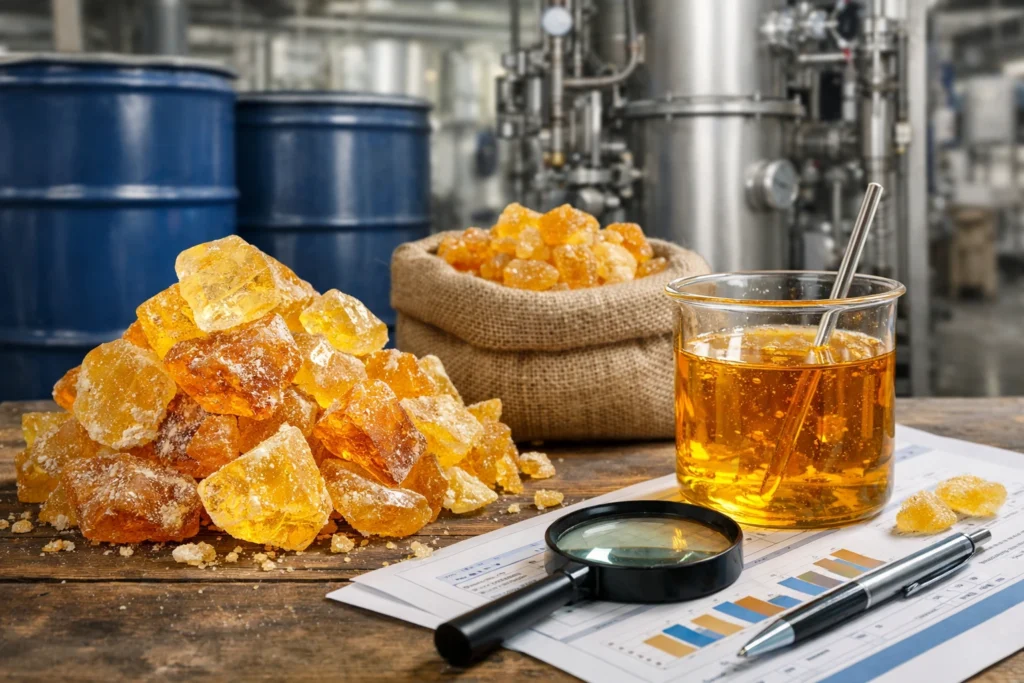
Gum Rosin Manufacturer selection is one of the most consequential supply chain decisions an industrial buyer can make in 2026. Whether you manufacture pressure-sensitive adhesives in Pune, print packaging inks in Ahmedabad, or compound rubber in Chennai, gum rosin sits at the heart of your formulation — and the origin, grade consistency, and reliability of your supplier directly determines product quality, production continuity, and export competitiveness.
Gum Rosin Manufacturer sourcing today means navigating domestic Indian producers, Chinese exporters, Brazilian suppliers, and Portuguese manufacturers — each with different lead times, quality standards, and documentation capabilities. As India’s dedicated gum rosin manufacturer and pine-based chemical supplier, SVD PineChem helps procurement managers, formulators, and distributors source with confidence — backed by verified quality, transparent documentation, and responsive supply chain support.
Gum Rosin Manufacturer buyers who rely solely on headline comparisons routinely underestimate the true cost of international procurement. This guide provides a structured, data-backed framework to evaluate domestic versus international sourcing and make the right decision for your operations in 2026.
Why Is Choosing the Right Gum Rosin Manufacturer So Important for Indian Industries in 2026?
Gum Rosin Manufacturer quality directly determines the performance of downstream products across adhesives, inks, coatings, rubber, and paper — sectors that together account for a substantial portion of India’s USD 220 billion chemical industry output (Indian Chemical Council, 2026). Batch-to-batch inconsistencies in acid value, softening point, or colour grade can trigger adhesive bond failures, ink viscosity drift, or paper sizing irregularities that cascade into costly production rejects and customer complaints.
Gum Rosin Manufacturer market demand has intensified sharply in 2026. India’s adhesive and sealant sector — one of the largest downstream consumers of gum rosin — is forecast to grow at 9.1% CAGR through 2030 (FICCI Chemical Industry Outlook, 2026). Simultaneously, India’s electronics manufacturing base, packaging industry, and printing ink sector are all expanding rapidly under government PLI and infrastructure stimulus programmes, tightening domestic rosin supply and raising quality expectations across the board.
Gum Rosin Manufacturer decisions made today lock in supply chain risk profiles for 12–24 months. A procurement team that switches to a new international supplier without rigorous due diligence may find itself managing quality disputes across a 9,000-kilometre supply chain with no accessible recourse mechanism and replacement lead times measured in months, not days.
What Are the Real Disadvantages of Sourcing from an International Gum Rosin Manufacturer?
Gum Rosin Manufacturer imports from China, Brazil, and Portugal involve a layered cost and complexity structure that consistently surprises buyers who evaluate sourcing decisions on an ex-works or FOB basis alone. Beyond the product value itself, international procurement adds sea freight, marine insurance, import duties, IGST, port handling and CFS charges, customs clearance fees, and inland logistics — a cumulative burden that frequently eliminates the apparent sourcing advantage when all components are correctly accounted for.
Gum Rosin Manufacturer import complexity also carries significant hidden time costs. Sea transit from China takes 18–28 days; customs clearance at JNPT or Chennai adds another 5–10 days; and inland delivery to the buyer’s facility adds further time — making a total procurement cycle of 36–90 days in even favourable conditions. For lean manufacturing operations responding to sudden demand changes, this lead time exposure is an operational vulnerability that domestic sourcing eliminates entirely.
Gum Rosin Manufacturer safety stock requirements follow directly from these lead times. Businesses importing gum rosin must hold 60–90 days of stock to absorb supply variability — working capital that is locked up and unavailable for other business priorities. Domestic sourcing reduces this buffer requirement to as little as 15–20 days, materially improving inventory efficiency and financial flexibility.
How Does Supply Chain Resilience Differ Between Domestic and International Gum Rosin Manufacturers?
Gum Rosin Manufacturer supply disruptions carry very different risk profiles depending on your sourcing origin. The COVID-19 pandemic, the 2021 Suez Canal blockage, the 2024 Red Sea freight crisis, and periodic Chinese export policy adjustments on pine chemicals have all demonstrated how fragile international chemical supply chains can be — exposures that a domestic Indian supplier is entirely insulated from.
What Lead Time Advantages Does a Domestic Gum Rosin Manufacturer Offer?
Gum Rosin Manufacturer delivery from a domestic Indian manufacturer typically takes 5–12 working days from order confirmation to facility delivery — even for orders in the 1–10 MT range. This compares to 36–90 days for sea-freight imports from China or Brazil, making domestic sourcing far better suited to just-in-time manufacturing models, urgent top-up requirements, and lean inventory operations.
How Does Quality Consistency Compare Between Domestic and Imported Gum Rosin?
Gum Rosin Manufacturer quality parameters — acid value, softening point, colour grade, moisture content, and unsaponifiable matter — must remain consistent batch to batch for downstream formulations to perform predictably. With an international supplier, buyers receive a Certificate of Analysis but have limited ability to verify the testing methodology, instrument calibration, or whether the COA is representative of the actual batch shipped.
According to SVD PineChem’s 2026 India market insights, the three most frequently cited quality complaints from Indian buyers who source imported gum rosin are: unexpected colour grade variation (e.g., receiving K-grade material on a WW-grade invoice), softening point drift causing hot-melt adhesive open-time failures, and elevated moisture content triggering haze formation in varnish and ink applications — each capable of causing significant batch write-offs and downstream customer issues.
Which Industrial Applications Demand the Highest Gum Rosin Quality Standards in India?
Gum Rosin Manufacturer grade selection and supplier quality are especially critical in the following high-specification application segments, where consistency carries the greatest downstream consequence:
- Hot-Melt and Pressure-Sensitive Adhesives: WW or WG-grade rosin and rosin esters are essential for PSA formulations in medical tapes, food packaging labels, and electronics masking. India’s adhesive tape market consumed an estimated 38,000 MT of rosin-based tackifiers in FY 2025–26.
- Electronics Soldering Flux: Ultra-pure WW-grade rosin is specified for no-clean and rosin-activated flux in PCB assembly. India’s electronics sector, targeted at USD 300 billion by 2026 under the PLI scheme (Ministry of Electronics and IT), is a growing consumer of electronics-grade rosin.
- Offset and Flexographic Printing Inks: Rosin-modified phenolic and rosin-maleic resins form the binder backbone of publication and packaging inks. Indian ink manufacturers source an estimated 15,000–18,000 MT of rosin-based resins annually.
- Paper Sizing: Internal paper sizing with fortified rosin emulsions requires consistent rosin acid content and stable emulsion behaviour. Indian paper mills — with total capacity exceeding 22 million MTPA (Paper Industry Association of India, 2026) — are major domestic rosin consumers.
- Thermoplastic Road Marking Paints: Rosin-modified hydrocarbon resin is a core binder in road marking formulations. India’s national highway expansion programme under NHAI’s 2026 budget creates sustained long-term demand growth for road marking grade rosin derivatives.
What Are the Key Advantages of Partnering with a Domestic Gum Rosin Manufacturer?
Gum Rosin Manufacturer sourcing from a domestic Indian manufacturer delivers structural advantages that international suppliers cannot replicate regardless of product quality or corporate scale:
- Direct auditability: Buyers can visit manufacturing facilities, review quality control systems in person, and build direct technical relationships — none of which is practically accessible with an overseas supplier.
- No import complexity: Domestic procurement involves no customs clearance, no import duties, no currency exposure risk, and no dependence on shipping container availability or freight rate volatility.
- Faster technical response: Grade queries, specification adjustments, and COA follow-ups are resolved in the same time zone, in the same language, within the same business day.
- Flexible minimum orders: Domestic manufacturers accommodate trial quantities, partial lots, and urgent top-up orders that international suppliers cannot fulfil economically.
- Government policy alignment: India’s AtmaNirbhar Bharat and PLI chemical sector incentives actively favour domestic procurement — a compliance and reputational advantage for manufacturers supplying government or PSU customers.
- Simplified re-export compliance: For exporters of rosin-containing finished goods, domestic sourcing simplifies origin documentation and phytosanitary certification for regulated destination markets.
How Does SVD PineChem Deliver on Quality, Documentation, and Supply Reliability?
At SVD PineChem, we specialize in manufacturing and distributing gum rosin and pine-based chemical derivatives that meet the quality demands of India’s most specification-driven industrial buyers — from pharmaceutical-adjacent adhesive formulators to high-volume paper mills and electronics component producers. Our supply model is built around five pillars:
- Verified quality: Every batch tested in-house for acid value (titrimetric), softening point (Ring & Ball), colour (Gardner scale and Lovibond tintometer), moisture (Karl Fischer), and unsaponifiable matter — with results in a batch-specific COA issued before dispatch.
- Grade range: Standard commercial grades (WW, WG, X, K, I) stocked for immediate dispatch, plus custom-specification supply for buyers with application-specific requirements outside standard grade parameters.
- Documentation completeness: COA, MSDS, GST-compliant tax invoice, and — for export buyers — DGFT-compliant commercial invoice, packing list, and phytosanitary or fumigation certificates as required by destination country regulations.
- Flexible order quantities: Domestic minimum from 50 kg for trial purposes; standard lots of 500 kg to 5 MT; bulk orders of 10–20 MT for large industrial consumers and distributors.
- Responsive communication: Dedicated account management and technical support for grade selection, formulation compatibility, and custom specification development — no time-zone gaps, no language barriers.
Conclusion: Build Your Gum Rosin Supply Chain on Verified Value, Not Just Price
Gum Rosin Manufacturer sourcing in 2026 demands a more sophisticated evaluation than a simple supplier-to-supplier comparison. When the full picture of international procurement is correctly assessed — accounting for lead times, import complexity, quality traceability risk, safety stock carrying costs, and supply chain resilience — domestic Indian manufacturers consistently emerge as the more reliable, commercially efficient, and technically supportable option for the vast majority of Indian industrial buyers.
Gum Rosin Manufacturer partnerships built on direct access, auditable quality systems, and same-day technical responsiveness eliminate the friction and hidden burdens that erode the apparent advantages of international sourcing. For export-oriented manufacturers, a domestic rosin supplier with strong documentation capabilities also simplifies the compliance requirements for re-exporting rosin-containing finished goods to regulated international markets.
SVD PineChem’s premium pine-based chemicals ensure that your gum rosin supply chain is built on verified quality, complete documentation, and operational reliability. Whether you need WW-grade rosin for electronics flux, standard commercial grades for adhesive tackifiers, or rosin derivatives for specialty ink resins, our team is ready to support your procurement with the technical expertise and supply responsiveness your operations require.
FAQ: Gum Rosin Manufacturing, Procurement & Applications in India
| Q1. What is gum rosin and how is it different from wood rosin and tall oil rosin? |
| Gum rosin (colophony) is extracted from the oleoresin tapped from living pine trees through steam distillation. Wood rosin is extracted from pine stumps and roots using solvent processes. Tall oil rosin is a by-product of the kraft paper pulping process. Gum rosin is generally lightest in colour, cleanest in odour, and highest in resin acid content — making it preferred for premium adhesives, electronics flux, and pharmaceutical applications. Wood and tall oil rosins are typically used in lower-grade industrial applications. |
| Q2. What quality tests should I insist on when sourcing gum rosin from any manufacturer? |
| At minimum, request a batch-specific COA reporting: acid value (mg KOH/g), softening point Ring & Ball (°C), colour grade (Gardner scale or Lovibond tintometer), moisture content (%), and unsaponifiable matter (%). For electronics or pharmaceutical-adjacent applications, also request GC analysis for specific resin acid composition. Any manufacturer unable or unwilling to provide complete batch-level testing data should be treated as a quality risk. |
| Q3. What is the minimum order quantity for gum rosin from SVD PineChem? |
| SVD PineChem accepts domestic orders from 50 kg for trial or sample requirements, with standard commercial lots at 500 kg to 5 MT. Export minimum orders typically start at 500 kg, with full container load (FCL) options of approximately 18–20 MT for high-volume international buyers. Custom grade or specification orders are available for qualifying volumes — contact svdpinechem.com/gum-rosin for current availability and lead times. |
| Q4. What are the main gum rosin grades and their applications? |
| Gum rosin is commercially graded by colour from WW (Water White, palest) through WG, X, K, I, H, G, F, and E (darkest). WW and WG grades are used in electronics flux, food-contact adhesives, and pharmaceutical applications. X and K grades serve standard adhesive, ink, and rubber compounding applications. I and lower grades are used in road marking paints and industrial rubber processing. |
| Q5. Can gum rosin be exported from India, and what documentation is required? |
| Yes. Gum rosin is exported from India under ITC-HS Code 3806.10. Required documentation includes: IEC (Import Export Code from DGFT), commercial invoice and packing list, bill of lading, COA and MSDS, and — for EU, USA, and food-contact markets — phytosanitary or fumigation certificates. Indian gum rosin is exported to major destinations including the USA, Germany, South Korea, UAE, and Vietnam. SVD PineChem provides complete export documentation support. |
| Q6. What pine-based chemicals does SVD PineChem manufacture in addition to gum rosin? |
| SVD PineChem’s product range includes gum rosin (all commercial grades), rosin esters (glycerol and pentaerythritol esters), turpentine oil (gum and wood), pine oil, synthetic camphor, Bhimseni camphor flakes, terpene resins, and related pine chemical derivatives covering adhesives, coatings, inks, fragrance, pharmaceuticals, rubber, and electronics applications — making SVD PineChem a single-source partner for pine-based chemical procurement. |
