

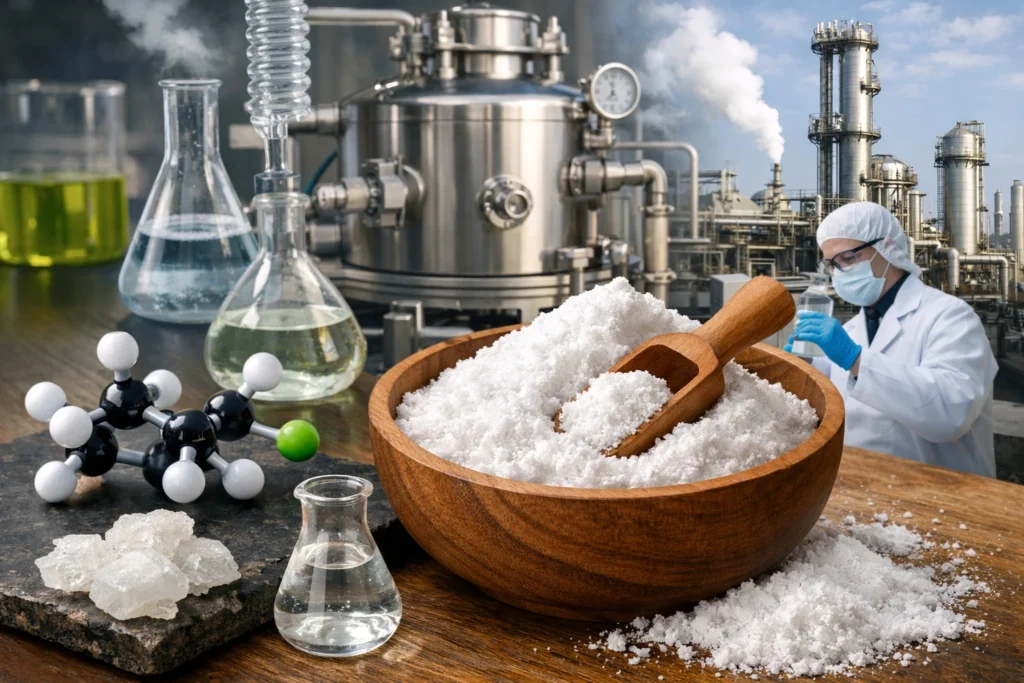
Isoborneol Powder is one of the most versatile and sought-after intermediates in the global specialty chemicals market — and its journey begins deep in the heart of India’s pine-rich forests. From fragrances and pharmaceuticals to resins and adhesives, this crystalline white compound serves as a critical building block across industries. Yet, surprisingly few buyers and industrial clients fully understand how isoborneol powder is made, or why the manufacturing process directly impacts its purity, performance, and price.
At SVD PineChem, we specialize in the end-to-end sourcing, processing, and distribution of high-grade pine-based chemicals across India and global markets. In this detailed guide, we walk you through every stage of isoborneol powder production — from raw material extraction to quality-certified bulk packaging — so that manufacturers, distributors, and industrial buyers can make confident, informed sourcing decisions. To explore our full product specifications and bulk pricing, visit our premium Isoborneol Powder product page.
What Exactly Is Isoborneol Powder, and Why Is It Important for Indian Industries in 2026?
Isoborneol Powder is a bicyclic monoterpenoid alcohol — a secondary alcohol derived from borneol or camphene — most commonly appearing as a white, crystalline powder with a characteristic camphor-like aroma. Chemically denoted as C₁₀H₁₈O, it is an important organic compound produced from alpha-pinene, the primary constituent of turpentine oil extracted from pine trees.
In 2026, isoborneol’s industrial relevance has grown substantially. According to industry estimates, the global terpenoid chemicals market is valued at approximately USD 8.2 billion, with South and Southeast Asia — particularly India — emerging as significant contributors to both supply and demand. India exports over ₹1,200 crore worth of pine-derived chemicals annually, with isoborneol accounting for a growing slice of that figure (Source: DGFT Export Data, FY 2025–26).
Isoborneol Powder plays a pivotal role across several Indian industrial sectors:
- Fragrance & Flavour Industry: Used as a raw material for camphor and borneol synthesis
- Pharmaceuticals: Serves as an intermediate in active pharmaceutical ingredient (API) manufacturing
- Resins & Adhesives: Acts as a modifier and fixative in specialty resin formulations
- Agrochemicals: Incorporated in certain pesticide and insect-repellent formulations
- Personal Care: Found in cooling agents, topical ointments, and aromatherapy products
SVD PineChem’s premium pine-based chemicals ensure consistent purity levels of 98–99.5% GC grade, enabling downstream manufacturers to maintain batch-to-batch consistency — a non-negotiable requirement for pharmaceutical and fragrance-grade applications.
Where Does the Raw Material Come From? Understanding the Pine Chemical Supply Chain
Isoborneol Powder production begins at the forest level. The primary feedstock is alpha-pinene, a monoterpene hydrocarbon abundantly found in turpentine oil — a byproduct of the pine resin tapping process. India’s conifer-rich states of Himachal Pradesh, Uttarakhand, and Jammu & Kashmir are among the most important domestic suppliers of crude turpentine oil.
According to India’s Forest Survey and Oleochemicals Council (2025–26 estimates), domestic turpentine oil production stands at approximately 55,000–60,000 metric tonnes per year. A significant portion of this is processed into pine chemicals, including alpha-pinene isolates that serve as the precursor for isoborneol powder.
What Are the Key Raw Materials Used in Isoborneol Powder Production?
The production of isoborneol powder relies on the following primary inputs:
- Alpha-Pinene: Sourced via fractional distillation of crude turpentine oil (boiling point ~156°C)
- Camphene: An isomerisation product of alpha-pinene, often used as an intermediate route
- Glacial Acetic Acid: Used in esterification steps depending on the production pathway
- Catalysts: Acid catalysts (e.g., p-toluenesulfonic acid) or heterogeneous solid catalysts
- Hydrogen: Required in selective hydrogenation steps for camphor-to-isoborneol routes
How Is Isoborneol Powder Made? A Step-by-Step Manufacturing Process
Isoborneol Powder can be produced through multiple synthetic routes. The most widely adopted commercial pathway in India follows the camphene-acetic acid esterification route, followed by saponification and crystallisation. Here is a detailed breakdown of the end-to-end process:
Step 1 — Turpentine Oil Distillation and Alpha-Pinene Isolation
Isoborneol Powder production starts with the careful fractional distillation of crude turpentine oil. Industrial distillation columns operating at atmospheric or reduced pressures separate alpha-pinene (bp ~155–156°C) from beta-pinene, camphene, and heavier terpene fractions. High-purity alpha-pinene (typically >96% purity) is drawn off and stored for the isomerisation step.
Step 2 — Catalytic Isomerisation of Alpha-Pinene to Camphene
Isoborneol Powder’s upstream chemistry involves the acid-catalysed isomerisation of alpha-pinene to camphene, a critical bicyclic intermediate. This reaction is typically conducted at temperatures of 150–200°C in the presence of acid catalysts such as titanium dioxide, activated clays, or zeolites. Camphene yields of 80–90% are achievable under optimised industrial conditions.
This step is thermodynamically controlled and requires precise temperature management to minimise the formation of undesirable by-products such as terpinolene and limonene.
Step 3 — Esterification of Camphene with Acetic Acid
Isoborneol Powder synthesis proceeds through the esterification of camphene with glacial acetic acid in the presence of an acid catalyst. The reaction produces isobornyl acetate — a highly valued fragrance compound in its own right, and the direct precursor to isoborneol. Reaction temperatures are maintained between 20–60°C. The esterification step is exothermic and requires careful heat management in jacketed reactors.
Step 4 — Saponification (Hydrolysis) to Isoborneol
Isoborneol Powder is obtained by hydrolysing isobornyl acetate through saponification — reacting the ester with a base (typically sodium hydroxide or potassium hydroxide) or through acidic aqueous hydrolysis. This reaction cleaves the acetate group, releasing isoborneol as a free secondary alcohol along with acetic acid (or sodium acetate as a co-product).
Reaction conditions are carefully controlled at near-neutral to mildly alkaline pH, at temperatures of 70–90°C, for reaction periods of 2–4 hours, depending on batch size and catalyst loading.
Step 5 — Purification, Crystallisation, and Drying
Isoborneol Powder emerges as a crude wet solid following the hydrolysis step. The purification process involves multiple washes with deionised water to remove residual salts and catalyst residues, followed by recrystallisation from suitable solvents (such as ethanol or isopropanol).
The purified crystals are then separated by centrifugation or filtration, and subjected to hot air or vacuum tray drying at 40–60°C. Final moisture content is controlled below 0.5% for pharmaceutical and fragrance applications.
Step 6 — Quality Testing and Certification
Isoborneol Powder leaving SVD PineChem’s production chain undergoes rigorous QC testing, including GC purity analysis (target: ≥99.0% GC grade), melting point verification (208–212°C), optical rotation measurement, residue on ignition, and heavy metals screening as per BP/USP/EP pharmacopoeial standards.
Step 7 — Packaging and Bulk Dispatch
Isoborneol Powder is packaged in 25 kg HDPE-lined fibre drums or 500 kg jumbo bags for bulk buyers. Export shipments are palletised and shrink-wrapped to international standards, complying with IMDG and IATA hazmat guidelines where applicable. SVD PineChem’s logistics network enables seamless export to the Middle East, Southeast Asia, and Europe via major Indian ports including Nhava Sheva (JNPT), Mundra, and Chennai.
What Are the Industrial Applications of Isoborneol Powder in 2026?
Isoborneol Powder’s multifunctional chemical profile makes it indispensable across a wide range of industrial sectors. In India and globally, demand is being driven by expansion in fragrance consumption, pharmaceutical API localisation, and the growing adoption of bio-based specialty chemicals.
Key application areas include:
- Camphor Synthesis: Oxidation of isoborneol with chromic acid or catalytic oxidation yields camphor — one of India’s most significant exported specialty chemicals (₹900+ crore export value, DGFT 2025–26)
- Fragrance Formulation: Used directly as a fixative and aroma modifier in fine fragrances, soaps, and household products
- Pharmaceutical Intermediates: Key building block for synthesis of terpene-based APIs, anti-inflammatory compounds, and transdermal penetration enhancers
- Specialty Resins: Incorporated in tackifier resins and adhesive formulations for improving bond strength and thermal stability
- Flavour Industry: Food-grade isoborneol used in limited concentrations as a flavouring agent under FSSAI and GRAS guidelines
- Agrochemical Formulations: Component in certain botanical insecticides and pest-repellent products gaining popularity as eco-friendly alternatives
Eco-Friendly Advantage: Isoborneol’s pine-derived, bio-based origin aligns with India’s National Chemical Policy 2025 priorities around green chemistry and sustainable industrial inputs — making it a preferred choice for environmentally-conscious manufacturers.
How Does SVD PineChem Ensure High-Quality Chemical Manufacturing?
According to SVD PineChem’s 2026 India market insights, quality assurance is not a final checkpoint — it is embedded at every stage of our manufacturing and supply chain operations. Our facilities maintain ISO 9001:2015 certification standards, and all production batches undergo multi-point quality verification aligned with international pharmacopoeial and industrial specifications.
Our quality framework includes:
- In-process sampling at distillation, isomerisation, and crystallisation stages
- GC-FID and GC-MS analysis using calibrated instruments with certified reference standards
- Dedicated QC laboratory with temperature-controlled storage for reference samples
- Complete batch traceability from raw material sourcing through to final dispatch
- Third-party analytical certification available for export shipments on request
SVD PineChem’s premium pine-based chemicals are trusted by over 200+ industrial clients across India, and we serve export customers in 18+ countries. Our commitment to consistent quality has earned us long-term partnerships with major players in the Indian fragrance, pharmaceutical, and adhesive industries.
People Also Ask — Quick Answers for Featured Snippets
What is Isoborneol Powder used for?
Quick Answer: Isoborneol Powder is primarily used in the production of camphor, fragrance formulations, pharmaceutical intermediates, specialty resins, adhesives, and agrochemical products. It is a bio-based pine chemical derivative valued for its versatility across industrial and consumer sectors.
How is Isoborneol Powder different from Borneol?
Quick Answer: Isoborneol and borneol are stereo-isomers — they share the same molecular formula (C₁₀H₁₈O) but differ in the spatial arrangement of the hydroxyl group. Isoborneol is the exo-isomer produced via camphene-based synthesis routes, while borneol is the endo-isomer. Isoborneol is more commonly used in industrial synthesis and camphor production.
Is Isoborneol Powder safe to handle?
Quick Answer: Isoborneol Powder is classified as a combustible solid and should be handled with appropriate PPE including gloves and eye protection. It should be stored away from heat sources and oxidising agents. Safety Data Sheets (SDS) compliant with GHS standards are provided by reputable suppliers with every shipment.
What is the minimum order quantity for Isoborneol Powder in India?
Quick Answer: Minimum order quantities in India typically start from 25 kg for pharmaceutical-grade and 50–100 kg for industrial and fragrance grades. Bulk order discounts are available for orders above 500 kg — contact SVD PineChem directly for a custom quotation.
Can Isoborneol Powder be exported from India?
Quick Answer: Yes. Isoborneol Powder is freely exportable from India and falls under HSN Code 2906.19. India is a competitive global supplier of pine-derived chemicals, and Indian manufacturers export to the EU, Middle East, Southeast Asia, and North America. Export documentation, including CoA, MSDS, and phytosanitary certificates where required, can be arranged by certified exporters.
What eco-friendly alternatives does Isoborneol Powder offer compared to synthetic chemicals?
Quick Answer: Isoborneol Powder is bio-derived from pine resin turpentine oil — a renewable, sustainably harvested forest resource. Unlike petroleum-derived chemical intermediates, pine-based chemicals including isoborneol offer a lower carbon footprint, biodegradability, and compliance with Green Chemistry principles, making them increasingly preferred by environmentally-conscious manufacturers globally.
Conclusion: Why Choose SVD PineChem as Your Isoborneol Powder Supplier?
Isoborneol Powder is far more than a commodity chemical — it is a precision-engineered, bio-based specialty compound that demands consistent quality, transparent sourcing, and reliable supply chain performance. Whether you are a fragrance formulator in Mumbai, a pharmaceutical API manufacturer in Hyderabad, a resin producer in Gujarat, or an export distributor serving European markets, the quality and traceability of your isoborneol supply directly impacts your product performance and regulatory compliance.
At SVD PineChem, we specialize in delivering exactly that. Our vertically integrated approach — from raw pine chemical sourcing in India’s northern forests to analytical QC, certified packaging, and export-ready logistics — ensures that every kilogram of isoborneol powder you receive meets the most demanding industrial and pharmacopoeial standards.
In 2026, as Indian and global industries accelerate their shift toward bio-based, eco-friendly chemical inputs, pine chemistry is firmly at the centre of this transformation. SVD PineChem is proud to be your trusted partner on this journey. To request a quotation, product specifications, or samples, visit our Isoborneol Powder product page or contact our sales team directly.
