

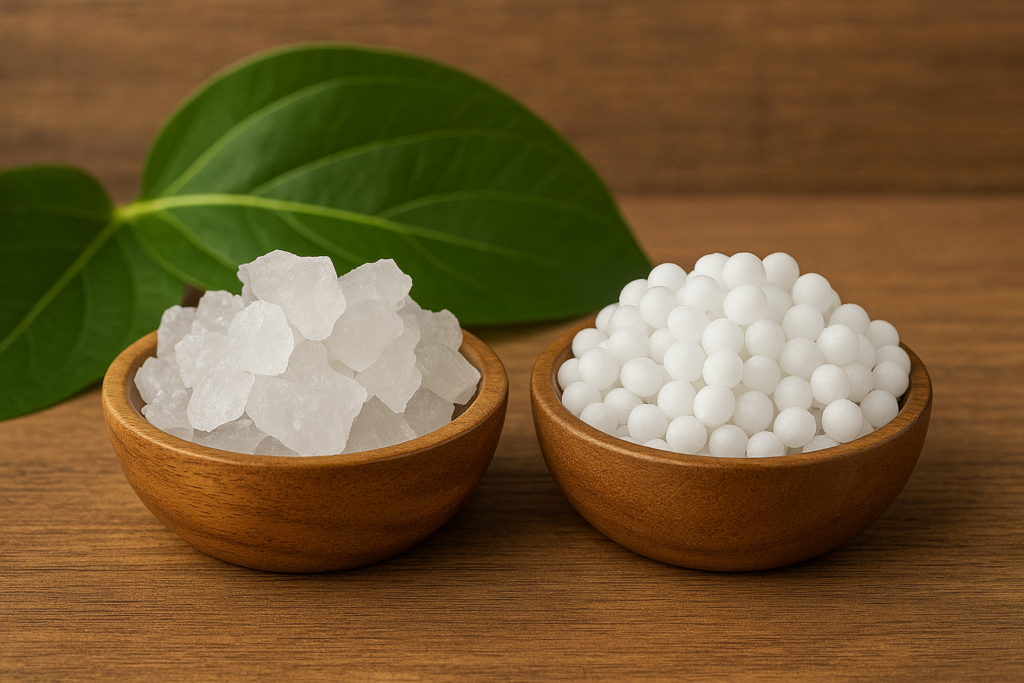
Bhimseni camphor, also known as Pacha Kapur or Desi Kapoor, represents the purest form of natural camphor derived from the bark and leaves of the Cinnamomum camphora tree through traditional steam distillation. As India’s Ayurveda industry surges to ₹1.9 lakh crore (~$22 billion) in 2025 with a robust 15% CAGR, quality-conscious Ayurvedic manufacturers face a critical decision: choosing between natural Bhimseni camphor and chemically produced synthetic variants. At SVD PineChem, we specialize in supplying premium-grade Bhimseni camphor and other pine-derived natural products to Ayurvedic manufacturers who prioritize authenticity, therapeutic efficacy, and regulatory compliance in their formulations.
The global Ayurvedic products and treatment market has reached USD 16.51 billion in 2025 and is projected to reach USD 77.42 billion by 2035, growing at 16.2% CAGR, with India contributing 17.9% annual growth. This exponential growth demands transparency about raw material quality, particularly for ingredients like camphor that hold both therapeutic and spiritual significance in traditional medicine. SVD PineChem has served the Indian pharmaceutical and Ayurvedic sectors for over 40 years, establishing our reputation through consistent quality, authenticity verification, and deep understanding of natural pine chemical properties that matter to formulators and traditional practitioners alike.
What Is Bhimseni Camphor and How Does It Differ from Synthetic Camphor?
Bhimseni camphor is 100% organic camphor obtained through meticulous steam distillation of Cinnamomum camphora tree parts, preserving natural properties and potency without undergoing chemical processing to create uniform tablets. The production process involves collecting fresh camphor leaves and bark from trees grown in Himalayan foothills and other suitable regions, followed by traditional steam distillation that yields pure crystalline camphor with characteristic uneven shapes and sizes. This natural camphor contains no artificial ingredients, binding agents, or chemical additives, making it suitable for medicinal, Ayurvedic, and aromatherapy applications.
Synthetic camphor, conversely, is manufactured through chemical processes using turpentine oil derived from pine resin or petroleum-based terpenes as raw materials. While synthetic camphor shares the same molecular formula (C₁₀H₁₆O) and can be molded into uniform shapes using binding compounds and chemicals, it lacks the subtle therapeutic qualities and natural purity of Bhimseni camphor. The Ayurvedic Pharmacopoeia of India specifically recognizes natural camphor obtained through steam distillation of Cinnamomum camphora leaves and bark as the correct pharmaceutical-grade material for traditional medicine applications.
How Can Ayurvedic Manufacturers Identify Pure Bhimseni Camphor?
Bhimseni camphor exhibits distinct physical characteristics that enable reliable identification through simple quality tests. Natural camphor appears as translucent or opaque crystals with uneven, irregular shapes and sizes, whereas synthetic camphor can be molded into uniform tablets and geometric forms. When crushed, pure Bhimseni camphor completely converts to fine powder form, while synthetic variants containing chemicals and binding agents leave waxy residue blocks.
The burning test provides the most reliable differentiation method for quality-conscious manufacturers. Bhimseni camphor burns with a smooth, soothing, long-lasting aroma and bright orange flame, evaporating completely without leaving any residue or ash behind. Synthetic camphor, by contrast, produces black smoke, a strong chemical smell similar to vapor rubs, and leaves noticeable residue after complete combustion. The water flotation test also distinguishes quality: pure Bhimseni camphor (Pakva camphor) is heavier and tends to settle in water, while many synthetic variants float immediately.
Why Does Camphor Quality Matter for Ayurvedic Formulations in 2025?
Bhimseni camphor’s therapeutic properties include documented antibacterial, anti-inflammatory, antitumor, antipyretic, and antimicrobial activities that are essential for authentic Ayurvedic medicine. Recent 2024 research demonstrates that camphor nanogels at 2500 µg/mL exhibit complete growth inhibition against Escherichia coli and Listeria monocytogenes, confirming potent antibacterial efficacy against both Gram-positive and Gram-negative pathogens. Studies also reveal that camphor lowers minimum inhibitory concentration (MIC) values of antimicrobial drugs and restores antibiotic sensitivity to previously resistant bacterial strains, offering synergistic benefits in antimicrobial therapy.
The Indian Pharmacopoeia (IP) specifies that pharmaceutical-grade camphor must contain ≥99% pure camphor content with melting point 175-177°C and specific physical characteristics including white crystalline appearance and characteristic camphor odor. Natural Bhimseni camphor meets these stringent IP standards without requiring chemical purification, making it the preferred choice for Ayurvedic manufacturers seeking regulatory compliance and authentic therapeutic action. Synthetic camphor, while chemically identical in molecular structure, may contain trace impurities from petroleum-based production processes that compromise traditional medicine principles emphasizing natural, plant-derived ingredients.
What Are the Key Quality Parameters Ayurvedic Manufacturers Should Monitor?
Bhimseni camphor quality assessment requires evaluation across multiple parameters aligned with Indian Pharmacopoeia standards and Ayurvedic authenticity requirements:
- Purity and Camphor Content: IP-grade camphor requires ≥99% pure camphor (CAS Number: 76-22-2) free from significant impurities
- Physical Appearance: Natural camphor appears as white crystalline powder or irregular crystals with translucent to opaque character and tough, pulverulent consistency
- Melting Range: Conforming material exhibits melting point 175-177°C as specified in IP standards
- Solubility Profile: Pure camphor dissolves readily in alcohol and ether while showing slight solubility in water
- Aroma Characteristics: Natural camphor produces smooth, soothing, long-lasting fragrance versus the harsh, chemical odor of synthetic variants
- Residue Test: Complete evaporation without ash or residue confirms natural purity
At SVD PineChem, we conduct comprehensive quality testing including heavy metal screening (arsenic, lead, mercury, cadmium, copper) and microbial analysis to ensure aerobic mesophilic bacterial count <100 CFU/g and yeast/mould count <10 CFU/g, meeting international pharmaceutical standards. Our natural camphor products undergo phytochemical screening for steroids, alkaloids, flavonoids, and tannins to verify authentic botanical origin and therapeutic compound profiles.
How Does Natural Camphor Support the Growing Ayurvedic Export Market?
India’s Ayurvedic manufacturing sector valued at USD 11 billion in FY22 includes exports worth approximately USD 5 billion, targeting markets in the US, EU, Japan, and Middle East where natural ingredient authentication is mandatory. International regulatory frameworks increasingly require herbal medicines to demonstrate botanical authenticity, quality consistency, and freedom from synthetic adulterants. Bhimseni camphor’s natural origin and traditional production methods align perfectly with these export market requirements, particularly for products marketed as “pure Ayurvedic” or “traditional herbal medicine”.
The Ayurvedic products market is projected to expand at 15% CAGR from FY23 to FY28, with the product sector growing at 16% annually, driven by rising global demand for natural and preventive healthcare solutions. European and North American consumers specifically seek authenticity verification and sustainable sourcing documentation for Ayurvedic products, making natural Bhimseni camphor a competitive advantage. SVD PineChem provides complete traceability documentation, including botanical source verification, steam distillation certification, and compliance with GACP (Good Agricultural and Collection Practices) standards that facilitate export approvals and international market access.
What Regulatory Standards Govern Camphor Quality in India for 2025?
The Bureau of Indian Standards specification IS 3584:2007 distinguishes between natural camphor (derived from Cinnamomum camphora) and synthetic camphor (manufactured product), requiring clear labeling of material origin for pharmaceutical applications. Indian Pharmacopoeia standards mandate that medicinal camphor must exhibit specific physical and chemical properties including characteristic penetrating odor, pungent aromatic taste followed by cooling sensation, and conformity to melting range and camphor content specifications.
Government initiatives including the National AYUSH Mission and Ministry of AYUSH quality control programs emphasize standardization and authentication of Ayurvedic raw materials to eliminate adulteration and ensure therapeutic efficacy. The growing enforcement of Good Manufacturing Practices (GMP) for Ayurvedic manufacturers requires documented quality testing and raw material authentication, particularly for ingredients listed in the Ayurvedic Pharmacopoeia of India. Natural Bhimseni camphor’s inherent compliance with traditional medicine definitions and pharmacopoeial specifications simplifies regulatory documentation compared to synthetic alternatives that require justification for traditional medicine use.
Why Are Leading Ayurvedic Manufacturers Choosing SVD PineChem for Bhimseni Camphor?
At SVD PineChem, our commitment to authenticity, quality, and traditional values has made us the preferred supplier for Ayurvedic manufacturers seeking genuine Bhimseni camphor and other natural pine chemicals. Our decades-long relationships with sustainable Cinnamomum camphora cultivators in Himalayan regions ensure consistent supply of premium raw materials harvested through environmentally responsible tree lopping practices that preserve forest ecosystems. We never use camphor trunk or roots in our distillation process, focusing exclusively on leaves and carefully selected bark portions to maintain sustainability.
Our Mumbai-based quality control laboratory performs comprehensive testing including physicochemical evaluation, heavy metal screening, microbial analysis, and phytochemical characterization to verify botanical authenticity and therapeutic compound profiles. This rigorous quality assurance enables Ayurvedic manufacturers to meet both domestic regulatory requirements and international export standards without additional verification costs. With India’s Ayurveda industry projected to reach ₹1.2 trillion by FY28, growing at 15% CAGR, partnering with reliable suppliers of authenticated natural ingredients like Bhimseni camphor becomes essential for maintaining market competitiveness and brand reputation.
Frequently Asked Questions About Bhimseni Camphor for Ayurvedic Manufacturing
Q: Can synthetic camphor be used in Ayurvedic formulations labeled as “natural” or “traditional”?
A: No. The Ayurvedic Pharmacopoeia of India specifies natural camphor obtained through steam distillation of Cinnamomum camphora as the correct ingredient for traditional formulations. Synthetic camphor derived from turpentine oil or petrochemicals does not qualify as natural or traditional medicine-grade material, potentially violating labeling regulations and traditional Ayurvedic principles.
Q: What is the typical price difference between Bhimseni camphor and synthetic camphor in 2025?
A: Natural Bhimseni camphor typically costs 40-70% more than synthetic camphor due to limited cultivation areas, traditional steam distillation processes, and seasonal availability. However, premium Ayurvedic brands justify this cost through superior therapeutic properties, export market acceptability, and authentic traditional medicine positioning that commands higher consumer prices.
Q: How should Ayurvedic manufacturers store Bhimseni camphor to maintain quality?
A: Store Bhimseni camphor in well-sealed, airtight containers away from heat, sparks, and open flames, as camphor is classified as a flammable solid (UN Transport Hazard Class 4.1). Maintain storage temperatures below 30°C in dry conditions with proper ventilation to prevent sublimation and preserve aromatic properties. Avoid direct sunlight and moisture exposure.
Q: Does Bhimseni camphor have stronger antimicrobial properties than synthetic camphor?
A: Research indicates natural camphor contains a broader spectrum of bioactive compounds beyond pure camphor molecule (C₁₀H₁₆O), including trace terpenes and phytochemicals that contribute synergistic antimicrobial effects. Studies demonstrate camphor’s effectiveness against S. aureus, E. coli, P. aeruginosa, and L. monocytogenes, with potential enhanced activity in natural forms retaining complete botanical compound profiles.
Q: Can Bhimseni camphor be used in edible Ayurvedic preparations?
A: Yes, pharmaceutical-grade natural Bhimseni camphor meeting Indian Pharmacopoeia standards (≥99% purity) is safe for oral Ayurvedic formulations when used in therapeutically appropriate doses under qualified practitioner guidance. Synthetic camphor containing production residues or chemical adulterants should not be used in edible preparations due to potential toxicity concerns.
Q: What documentation should Ayurvedic manufacturers request from Bhimseni camphor suppliers?
A: Request Certificate of Analysis (CoA) showing camphor content ≥99%, melting point 175-177°C, heavy metal test results, microbial analysis confirming <100 CFU/g bacterial count, botanical source certification verifying Cinnamomum camphora origin, steam distillation process documentation, and GACP (Good Agricultural and Collection Practices) compliance certificates for export-oriented products.
