

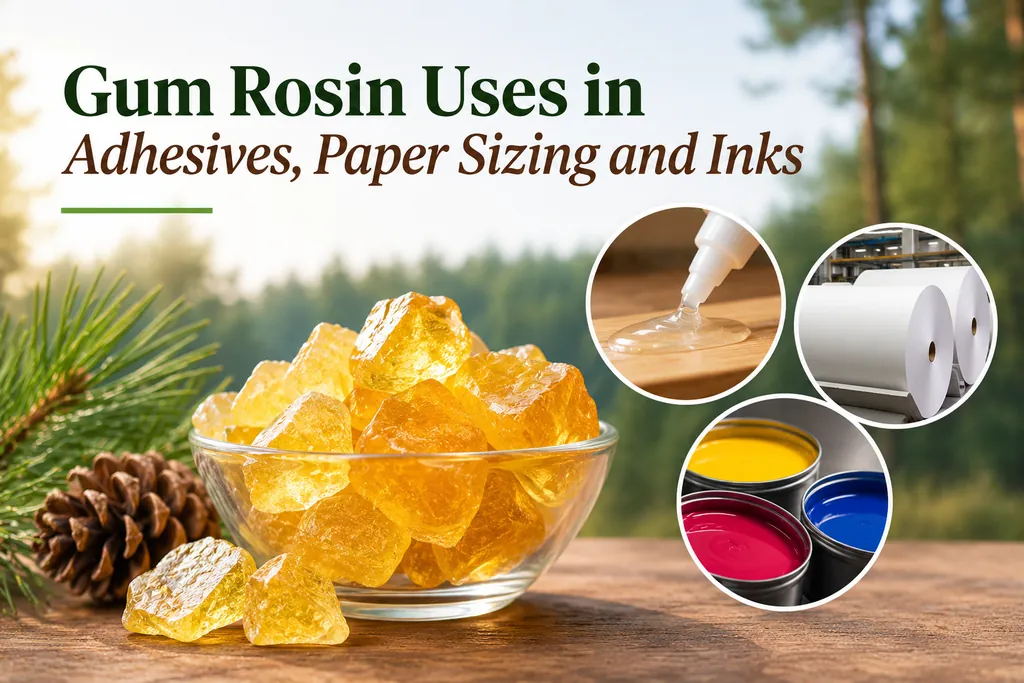
Gum rosin uses in adhesives, paper sizing and inks make it one of the most useful natural resins in industry, because it adds tack, adhesion, gloss and water resistance at a reasonable cost. Rosin and its derivatives sit inside hot-melt glues, paper mills and printing inks, often without the end user ever knowing. This guide explains how gum rosin is used in each of these industries, which properties matter and what industrial buyers should ask their supplier. Learn about SVD PineChem’s gum rosin on its product page.
What makes gum rosin useful in industry
SVD PineChem describes gum rosin as a solid resin obtained from living pine trees and lists its use in paper, inks, paints, adhesives, rubber, soaps, chewing gum and other applications. Rosin is made mostly of resin acids, which gives it tack, adhesion, film-forming ability and compatibility with many polymers and solvents. Rosin can also be chemically modified into esters and other derivatives that offer higher softening points and better stability. A general overview is available in this page on rosin.
Gum rosin uses in adhesives
In adhesives and sealants, rosin and rosin esters work as tackifiers. A tackifier makes an adhesive stick quickly on contact and helps it wet the surface being bonded. SVD PineChem notes that gum rosin contributes tackiness, cohesion and strength in adhesives and sealants.
- Hot-melt adhesives: tackifier resins help control open time, grip and bond strength.
- Pressure-sensitive adhesives: rosin-based resins help give the initial stick of tapes and labels.
- Sealants and mastics: improve adhesion to a range of surfaces.
- Packaging and bookbinding: used in many general-purpose glues.
When you choose rosin for adhesives, check softening point, colour, acid value and thermal stability, since adhesives are heated and must not darken or degrade in processing.
Gum rosin uses in paper sizing
Paper without sizing absorbs liquids like a blotter. Sizing makes paper resist water and ink penetration, so that writing, printing and packaging performance are controlled. Rosin has been used for this purpose for a long time, and you can read about it under sizing. In rosin sizing, rosin is converted into a size, often a soap or dispersion, and added to the pulp, where it is fixed onto the fibres, usually with alum. The result is paper that resists wetting to a controlled degree.
- Writing and printing papers: prevent ink feathering and bleeding.
- Packaging boards and cartons: add water resistance.
- Specialty papers: sizing level is adjusted to the end use.
For sizing, acid value, colour and consistency of the rosin are important, because they affect size preparation and the whiteness of the paper.
Gum rosin uses in printing inks
In printing inks, rosin and its derivatives act as binders and resins that carry the pigment and help the ink adhere to the substrate. SVD PineChem lists printing inks among its key application areas, noting benefits such as gloss, adhesion and colour retention. Rosin-modified resins are widely used in offset and publication gravure inks and in varnishes and overprint lacquers.
- Gloss and finish: rosin-based resins help produce a glossy film.
- Adhesion to paper and board: helps ink bond and resist rub.
- Pigment wetting: helps disperse pigments for strong colour.
- Compatibility: works with oils and solvents used in ink systems.
Gum rosin uses compared across adhesives, paper and inks
|
Tier |
Industry |
Role of rosin |
Key properties to check |
|
Tier 1 |
Adhesives and sealants |
Tackifier, improves adhesion and cohesion |
Softening point, colour, thermal stability |
|
Tier 1 |
Paper sizing |
Controls water and ink absorption |
Acid value, colour, consistency |
|
Tier 1 |
Printing inks and varnishes |
Binder resin for gloss, adhesion and pigment wetting |
Colour, solubility, acid value |
|
Tier 2 |
Paints and coatings |
Gloss, adhesion and weather resistance |
Colour, compatibility |
|
Tier 2 |
Rubber and plastics |
Improves flexibility and processing |
Softening point, purity |
|
Tier 3 |
Soaps, chewing gum and other uses |
Functional and formulation ingredient |
Grade and regulatory requirements |
Other gum rosin uses
Beyond these three industries, SVD PineChem lists paints and coatings, rubber and plastics, food packaging and pharmaceuticals, where it says gum rosin can serve as an excipient, including in controlled-release medicines. Rosin is also used in soaps, soldering flux, chewing gum bases and many other products. Regulatory rules for food, drug and cosmetic uses vary, so buyers should confirm that a grade is permitted for their intended use.
How to choose gum rosin for your industry
- Define the application and required properties before talking to suppliers.
- Ask for specifications: grade, softening point, acid value, impurities and moisture.
- Request samples and run trials in your actual formulation.
- Check batch-to-batch consistency over several lots.
- Confirm documentation, including certificate of analysis and safety data sheet.
- Discuss packaging, lead time and stock levels for regular supply.
SVD PineChem says it stores gum rosin in bulk for timely delivery and routinely provides specific products for particular client requirements, so discuss your formulation needs with the team. For related pine-based materials, see pine terpenes and where they are used.
Quality problems linked to gum rosin uses and how to avoid them
Many process problems trace back to the rosin. Darkening in a hot-melt adhesive can come from thermal ageing or a grade that is too dark, inconsistent sizing can come from variation in acid value, and poor gloss in an ink can come from incompatibility or impurities. When a problem appears, compare the current lot with a retained sample, check the certificate and test softening point and colour. Work with your supplier to adjust the grade or the process instead of changing several things at once, and keep retained samples from each lot so that you can trace changes quickly.
Explore More from SVD PineChem
Use these links to go straight to the products and guides mentioned in this article.
- Products: Gum rosin | Pine terpenes | Camphor powder | Isoborneol powder | Bhimseni camphor flakes | Paraffin wax | All products
- Guides: Pine terpenes: what they are | Bulk pine oil suppliers in Mumbai | Paraffin wax grade selection guide
Match gum rosin uses to your process
Gum rosin uses in adhesives, paper sizing and inks all depend on a few properties: colour, softening point, acid value and consistency. Test a sample, check the certificate and agree the specification in writing so each batch performs the same. SVD PineChem supplies gum rosin and other pine chemicals from Mumbai to industrial buyers in India and overseas.
Planning to use gum rosin in adhesives, paper or inks? Share your application and volume. Call +91 8655768338 or +91 22 23686252, email info@svdpinechem.com or contact SVD PineChem through the enquiry form. The team replies to enquiries within 24 hours by email.
Frequently Asked Questions
What are the main gum rosin uses?
Adhesives and sealants, paper sizing, printing inks, paints and coatings, rubber, soaps, chewing gum and other industrial applications.
How is gum rosin used in adhesives?
As a tackifier that improves tack, adhesion, cohesion and strength, especially in hot-melt and pressure-sensitive adhesives.
What is rosin sizing in paper?
Rosin is converted into a size that is added to paper pulp so the paper resists water and ink penetration.
Why is rosin used in printing inks?
It helps provide gloss, adhesion and pigment wetting, and works as a binder resin in many ink systems.
Which rosin properties matter most?
Colour, softening point, acid value, impurities and consistency, depending on the application.
Can gum rosin be modified?
Yes. It can be converted into esters and other derivatives with higher softening points and better stability.
Is gum rosin used in food and pharma?
SVD PineChem lists food packaging and pharmaceutical excipient uses. Confirm regulatory suitability for your product.
Do I need a sample before buying?
A trial in your own process is recommended before placing a bulk order.
Can SVD PineChem supply gum rosin in bulk?
The company states that it stores gum rosin in bulk for timely delivery.
How do I contact SVD PineChem?
Call +91 8655768338 or +91 22 23686252, email info@svdpinechem.com or use the contact form.
