

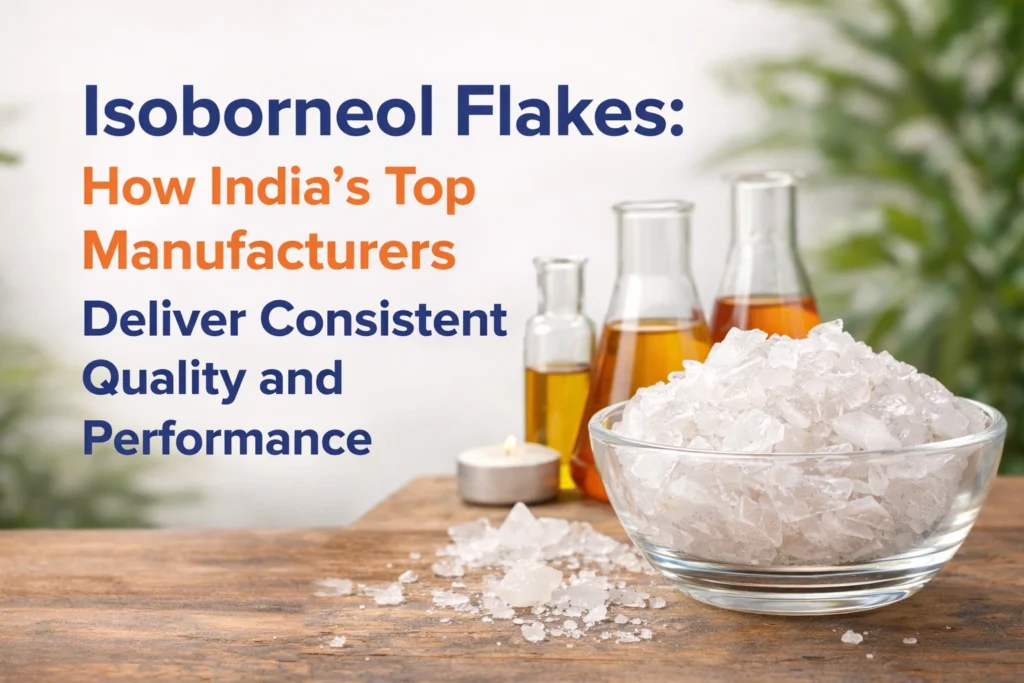
Isoborneol Flakes are emerging as one of the most strategically important specialty chemicals sourced from India’s rich pine-based chemical ecosystem. A white, crystalline bicyclic monoterpenoid alcohol with the molecular formula C₁₀H₁₈O, isoborneol is prized across fragrance, pharmaceutical, personal care, and fine-chemical manufacturing for its characteristic camphor-like aroma, antimicrobial properties, and versatility as a synthesis intermediate.
In 2026, the global isoborneol flakes market — valued at approximately USD 26.3 million — is on a steady growth path, projected to reach USD 34.1 million by 2032 at a CAGR of 3.9%, according to Intel Market Research. Asia-Pacific accounts for over 65% of total global production, with India rapidly strengthening its position as a high-quality, export-ready source of pine-derived terpenoid chemicals.
At SVD PineChem, we specialize in end-to-end sourcing, processing, and distribution of premium isoborneol flakes and isoborneol powder for industrial, pharmaceutical, and export-grade applications. In this guide, we walk you through exactly how India’s top manufacturers deliver consistent quality — and why partnering with the right Indian supplier can transform your sourcing strategy in 2026.
What Are Isoborneol Flakes and How Are They Derived from Pine?
Isoborneol Flakes are the solid crystalline form of isoborneol — a naturally occurring secondary alcohol that is a stereoisomer of borneol. Commercially, isoborneol is produced from alpha-pinene, the primary constituent of turpentine oil extracted from pine tree oleoresin. The production pathway involves the acid-catalysed hydration of alpha-pinene to camphene, followed by esterification and subsequent saponification and oxidation steps — a process that India’s specialist pine-chemical manufacturers have refined to achieve consistently high purity levels.
Isoborneol Flakes differ from isoborneol powder in particle size and handling characteristics. The flake form offers improved ease of handling, reduced dust exposure during processing, and better flow properties in industrial filling and blending operations — making it the preferred form for pharmaceutical manufacturers, fragrance compounders, and large-scale chemical processors. Both forms are commercially available in purity grades above 95% and above 98%, with pharmacopoeial (IP/BP) grades available for pharmaceutical applications.
Key Chemical Properties of Isoborneol Flakes
- Molecular formula: C₁₀H₁₈O — bicyclic monoterpene alcohol
- Appearance: white to off-white crystalline flakes with characteristic camphor-like odour
- Melting point: 212–214°C; boiling point approximately 212°C
- Purity grades: Industrial (>95%), Pharmaceutical/FCC (>98%), and AR (analytical reagent) grades
- Solubility: readily soluble in ethanol, chloroform, and ether; slightly soluble in water
- Key functional properties: antimicrobial, fixative, cooling sensation, synthesis intermediate
Why Are Indian Isoborneol Flakes Manufacturers Gaining Global Recognition in 2026?
Isoborneol Flakes manufactured in India benefit from a deeply integrated, domestic pine-chemical supply chain that begins in the Himalayan pine forests of Himachal Pradesh, Uttarakhand, and Jammu & Kashmir. These forests are among the world’s most significant natural sources of Pinus roxburghii (chir pine) oleoresin — the upstream raw material from which turpentine oil, and subsequently alpha-pinene and isoborneol, are derived. This natural endowment gives Indian manufacturers a fundamental feedstock advantage over competitors reliant on imported raw materials.
India exports over ₹1,200 crore worth of pine-derived chemicals annually, with isoborneol accounting for a growing share of that figure according to DGFT export data for FY 2025–26. The global terpenoid chemicals sector, within which isoborneol sits, is valued at approximately USD 8.2 billion — and South and Southeast Asia are becoming increasingly dominant as both producers and consumers of these bio-based specialty chemicals.
| According to SVD PineChem’s 2026 India market insights, increasing regulatory pressure in the EU, North America, and Japan to replace synthetic chemical intermediates with bio-based, naturally-derived alternatives is driving a measurable shift in procurement priorities among global buyers — and Indian pine-chemical manufacturers are exceptionally well-positioned to benefit. |
Isoborneol Flakes from India also carry a significant sustainability credential. Derived from pine oleoresin tapped from living trees using sustainable forestry practices, isoborneol is inherently bio-based and renewable. This aligns with India’s National Chemical Policy 2025 priorities around green chemistry, and satisfies ESG procurement mandates increasingly imposed by buyers across the EU, UK, and Japan markets. For international buyers seeking to reduce their supply chain’s carbon footprint, Indian-sourced isoborneol flakes represent a compelling, traceable, and renewable alternative to petrochemical-based aroma chemicals.
How Does SVD PineChem Ensure High-Quality Isoborneol Flake Manufacturing?
Isoborneol Flakes from SVD PineChem are produced under a quality assurance framework that is embedded at every stage — not applied as a final checkpoint. Our facilities maintain ISO 9001:2015 certification standards, and all production batches undergo multi-point quality verification aligned with international pharmacopoeial and industrial specifications, including Indian Pharmacopoeia (IP), British Pharmacopoeia (BP), and FCC (Food Chemical Codex) standards where applicable.
Isoborneol Flakes are subject to rigorous in-process controls including gas chromatography (GC) purity analysis, melting point verification, acid value testing, and residue on evaporation checks. Each outgoing batch is accompanied by a full Certificate of Analysis (CoA) and Safety Data Sheet (SDS) — critical documentation for regulated industries such as pharmaceuticals, cosmetics, and food flavouring.
SVD PineChem’s Multi-Stage Quality Verification Process
- Raw material intake: GC purity assessment of incoming turpentine oil and alpha-pinene feedstock
- In-process control: temperature, pressure, and yield monitoring at each reaction and distillation stage
- Crystallisation quality: crystal morphology, particle size distribution, and moisture content verification
- Finished-product testing: GC purity (>95% or >98%), melting point, acid value, and colour assessment
- Packaging integrity: hermetically sealed HDPE drums and laminated kraft bags with desiccant protection for moisture-sensitive flake form
- Batch documentation: full CoA, SDS, REACH compliance declarations, and export quality certificates
What Are the Key Industrial Applications of Isoborneol Flakes in 2026?
Isoborneol Flakes serve as a critical input across a surprisingly diverse range of industries. The personal care and fragrance sector accounts for over 40% of total global isoborneol consumption — a figure that has grown consistently as consumers and brands shift toward naturally-derived aroma ingredients. But isoborneol’s applications extend well beyond perfumery, encompassing pharmaceutical synthesis, agricultural chemistry, flavour compounding, and specialty resin manufacturing.
KEY APPLICATIONS AT A GLANCE
| 01 | Fragrance & Personal Care Natural fixative and aroma chemical in perfumes, soaps, deodorants, and skincare formulations; valued for camphor-like freshness and antimicrobial properties. |
| 02 | Pharmaceuticals Synthesis intermediate for camphor, borneol, and related monoterpene derivatives used in topical analgesics, anti-inflammatory formulations, and traditional medicine. |
| 03 | Food & Flavours FCC-grade isoborneol flakes used as a flavouring agent and aroma contributor in approved food and beverage applications in regulated markets. |
| 04 | Fine & Specialty Chemicals Intermediate in the synthesis of camphane derivatives, resins, and specialty organic compounds; used in chemical solvents and agricultural chemistry. |
| 05 | Adhesives & Coatings Terpene-based resins derived from isoborneol find application in specialty adhesives, varnishes, and surface coatings, particularly in eco-labelled product lines. |
| 06 | Traditional & Ayurvedic Medicine Recognised ingredient in Ayurvedic and traditional Chinese medicine preparations; growing demand from India’s booming wellness and herbal products sector. |
Isoborneol Flakes are also gaining traction in the insect repellent and crop protection segment, where their natural antimicrobial and repellent properties make them an attractive bio-based active ingredient. SVD PineChem’s premium pine-based chemicals ensure that each grade of isoborneol we supply is matched precisely to the end application — whether that is a pharmacopoeial-grade batch destined for a pharmaceutical plant or an industrial-grade consignment for specialty resin compounding.
What Is the Export Potential of Isoborneol Flakes from India in 2026?
Isoborneol Flakes from India are exported to over 18 countries across Southeast Asia, the Middle East, Europe, and North America. The product is classified under HS Code 2906.29 (cyclic alcohols and their derivatives) and is freely exportable under DGFT regulations, with no export restrictions currently applicable. For international buyers, India-origin isoborneol flakes offer a credible and geographically diversified alternative to Chinese-manufactured product — a significant consideration given the supply chain diversification strategies now being pursued by global chemical procurement teams.
Isoborneol Flakes are typically exported in 25 kg HDPE drums, 50 kg fibre drums, or 500 kg jumbo bags, depending on customer preference and destination market regulations. Sea freight from Indian west coast ports — primarily Nhava Sheva (JNPT) and Mundra — provides reliable access to markets in the Middle East (10–15 days), Europe (20–25 days), and Southeast Asia (8–14 days). For time-sensitive pharmaceutical or fragrance orders, air freight from major Indian airports is also available with full GMP-compliant documentation.
How Does Isoborneol Support Eco-Friendly and Green Chemistry Goals?
Isoborneol Flakes occupy a privileged position in the shift toward green chemistry. As a pine-derived, bio-based compound, isoborneol is inherently renewable, biodegradable, and produced from a feedstock — pine oleoresin — that is harvested through sustainable tapping practices that do not require tree felling. This is a meaningful distinction from synthetically derived aroma chemicals and pharmaceutical intermediates that rely on petroleum-based feedstocks and multi-step synthetic pathways with higher environmental burdens.
The European Chemicals Agency (ECHA) and the US Environmental Protection Agency (EPA) have both articulated frameworks that favour naturally derived chemical inputs in formulated products — trends that are driving procurement shifts in the global cosmetics, pharmaceutical, and flavour industries. For Indian manufacturers of isoborneol flakes, these regulatory tailwinds translate directly into growing export demand from compliant markets seeking verified, bio-based supply.
- Bio-based origin: derived from pine oleoresin, a renewable natural resource
- Sustainable sourcing: pine tapping practices preserve living trees and support forest ecosystem services
- Biodegradable: isoborneol degrades naturally without persistent environmental accumulation
- Aligns with India’s National Chemical Policy 2025 and global ESG procurement mandates
- Supports green chemistry principles: replaces petroleum-derived aroma chemicals in fragrance and pharmaceutical formulations
People Also Ask
Q What is the difference between isoborneol flakes and isoborneol powder?
Isoborneol flakes and isoborneol powder have the same chemical composition (C₁₀H₁₈O) but differ in particle size and physical form. Flakes are larger, flat crystalline pieces that offer reduced dust generation, easier handling, and better flow properties in industrial processing. Powder is a finer form preferred where rapid dissolution or blending into formulations is required. Both forms are available in industrial and pharmaceutical purity grades.
Q Which industries use isoborneol flakes the most in India?
In India, the largest consumers of isoborneol flakes are the fragrance and personal care industry (perfumes, soaps, deodorants), the pharmaceutical sector (topical analgesics, Ayurvedic preparations), and the fine chemicals industry (synthesis intermediates). The food flavouring and agricultural chemistry sectors are growing secondary markets.
Q Can isoborneol flakes be exported from India?
Yes. Isoborneol flakes are freely exportable from India under DGFT regulations with no export restrictions. They are classified under HS Code 2906.29 (cyclic alcohols and derivatives). Indian exporters can provide full documentation including certificate of origin, certificate of analysis, SDS, and REACH compliance declarations for regulated export markets.
Q What purity grades of isoborneol flakes are available from Indian manufacturers?
Indian manufacturers typically offer isoborneol flakes in Industrial Grade (>95% purity), Pharmaceutical/FCC Grade (>98% purity), and Analytical Reagent (AR) Grade. Pharmacopoeial grades meeting Indian Pharmacopoeia (IP) and British Pharmacopoeia (BP) specifications are also available from certified manufacturers for regulated pharmaceutical applications.
Frequently Asked Questions
| How is isoborneol produced from pine-derived raw materials? |
| Isoborneol is commercially produced from alpha-pinene — the primary constituent of turpentine oil derived from pine oleoresin. The production process involves the acid-catalysed hydration of alpha-pinene to camphene, followed by esterification to bornyl acetate, saponification to borneol, and finally oxidation and reduction steps to yield isoborneol. The resulting product is purified through distillation and crystallised into flake or powder form. Indian manufacturers with vertically integrated facilities — incorporating turpentine distillation, alpha-pinene separation, and isoborneol crystallisation in a single supply chain — are able to deliver superior traceability and consistency. |
| What quality certifications should I look for in an Indian isoborneol flakes supplier? |
| When evaluating Indian isoborneol flakes suppliers, buyers should look for ISO 9001:2015 quality management certification, product-specific Certificates of Analysis (CoA) with GC purity data, compliance with pharmacopoeial standards (IP, BP, or USP) for pharmaceutical buyers, and REACH compliance documentation for exports to the EU. For food-grade applications, FCC (Food Chemical Codex) certification is important. DGFT registration and IEC (Importer Exporter Code) are required for export operations. |
| What is the minimum order quantity (MOQ) for isoborneol flakes from SVD PineChem? |
| SVD PineChem accommodates trial sample requests and small commercial orders for buyers evaluating our product quality, with standard commercial volumes available in full drum orders (25 kg or 50 kg units) or larger bulk packs. For export customers, full container load (FCL) orders of multiple metric tonnes qualify for optimised logistics and pricing. Contact our sales team directly to discuss your specific quantity, grade, and delivery requirements. |
| How should isoborneol flakes be stored and handled? |
| Isoborneol flakes should be stored in a cool, dry, well-ventilated area away from direct sunlight and heat sources, with a recommended storage temperature of 15–25°C. The product is moisture-sensitive and should be kept in tightly sealed containers. Standard personal protective equipment (PPE) — gloves, eye protection, and a dust mask — is recommended during handling to avoid inhalation of flake dust. Refer to the product SDS for full handling, storage, and disposal guidance. |
| How does isoborneol differ from camphor, and can it replace camphor in formulations? |
| Isoborneol (C₁₀H₁₈O) and camphor (C₁₀H₁₆O) are closely related monoterpene compounds with similar camphoraceous aromas, but they differ chemically — camphor is a ketone while isoborneol is a secondary alcohol. They are not direct drop-in substitutes, as they behave differently in formulations. Isoborneol is commonly used as a precursor in camphor synthesis, and in some fragrance and pharmaceutical formulations it can provide similar cooling or aromatic properties. Always confirm suitability with your formulation chemist before substituting. |
| Which export markets have the highest demand for Indian isoborneol flakes? |
| Based on 2025–26 DGFT export data and SVD PineChem’s customer base, the highest-demand export markets for Indian isoborneol flakes include the United Arab Emirates (UAE), Germany, the United Kingdom, Japan, South Korea, Indonesia, and the United States. The Middle East is a particularly strong regional market due to high fragrance compounding activity, while European buyers increasingly seek bio-based, sustainably sourced Indian chemical intermediates to meet ESG procurement requirements. |
Conclusion: Why SVD PineChem Is Your Ideal Isoborneol Flakes Partner
Isoborneol Flakes sourced from India’s leading pine-chemical manufacturers represent a convergence of quality, sustainability, and supply chain resilience that is increasingly difficult to find from alternative origins. From the high-altitude pine forests of northern India to the carefully controlled crystallisation lines of certified manufacturing facilities, every step of the value chain contributes to a product that meets the most demanding international standards.
SVD PineChem’s premium pine-based chemicals are trusted by over 200 industrial clients across India and exported to 18+ countries — a track record built on consistent quality, transparent documentation, and a genuine understanding of our customers’ formulation and regulatory needs. Whether you are a fragrance compounder in Europe, a pharmaceutical manufacturer in India, or a specialty chemical distributor in the Middle East, we have the grade, the documentation, and the logistics capability to serve you reliably.
