

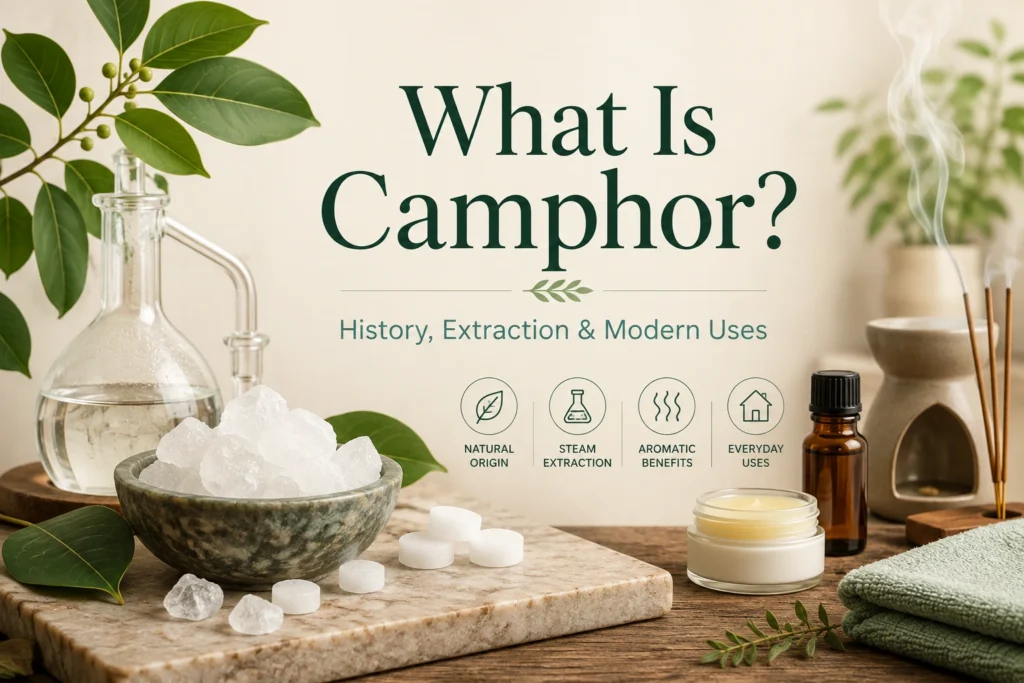
Few materials bridge ancient ritual and modern industry as seamlessly as camphor. The same white, aromatic crystalline substance burned in temples for centuries is today manufactured at industrial scale for pharmaceuticals, cosmetics, and household products. Its distinctive scent is instantly recognizable – but most people have never learned where it actually comes from or how it’s made.
This guide covers the history of camphor, how it’s extracted and manufactured today, and the wide range of applications that keep demand for it strong across religious, industrial, and consumer markets.
What Is Camphor?
Camphor is a white, crystalline, waxy solid with a strong, penetrating aroma, chemically classified as a terpenoid. It’s known for subliming easily – meaning it can pass directly from a solid to a vapor at room temperature, which is part of why its scent is so immediately noticeable and long-lasting.
The History of Camphor
Camphor has one of the longer documented histories among aromatic natural materials, with recorded use across South and East Asian cultures for well over a thousand years. Historically, it was obtained from the camphor laurel tree (Cinnamomum camphora), native to Asia, by steam-distilling wood chips from the tree – a labor-intensive process that made natural camphor a valued and, at times, expensive commodity in early trade.
Camphor’s traditional uses have deep cultural roots. In Hindu religious practice, it has been burned in aarti and havan ceremonies for centuries, valued both for its pure-burning flame and its aromatic smoke. It also has a long history of traditional use in balms and preparations across multiple traditional medicine systems in Asia, long before its chemical structure was even understood.
How Camphor Is Made Today
Here’s something many people don’t realize: most camphor manufactured today is not extracted from the camphor laurel tree at all.
While natural camphor extraction from Cinnamomum camphora wood still occurs in some regions, the vast majority of commercial camphor today is produced through the chemical synthesis of turpentine, which is itself derived from pine trees. This shift happened for practical reasons – turpentine-derived synthetic camphor offers more consistent purity, more reliable large-scale supply, and doesn’t depend on harvesting slow-growing camphor laurel trees.
The general production pathway looks like this:
- Turpentine is obtained as a by-product of pine resin processing (the same broad category of raw material used to produce gum rosin).
- The turpentine undergoes a series of chemical conversion steps, transforming its primary component (alpha-pinene) through intermediate compounds into camphor.
- The resulting camphor is purified and crystallized into the fine white powder or flake form used commercially.
This is a good example of how interconnected the pine chemicals industry really is – the same raw material stream that produces gum rosin for adhesives and paints also, through further processing, becomes the camphor used in temples, medicine cabinets, and cosmetics around the world.
Note on terminology: You may also come across “Bhimseni camphor” (also called Bhimseni Kapoor) – this refers to a specific, highly valued form of camphor traditionally associated with natural extraction and prized in religious use for its purity and distinct crystal form, and it’s often treated as a separate product category from standard synthesized camphor powder.
Modern Uses of Camphor
Camphor’s versatility is what has kept it commercially relevant across such different sectors. Here’s where it shows up today:
Religious & Spiritual Use Camphor remains central to Hindu rituals, including aarti and havan ceremonies, where it’s valued for burning cleanly with minimal residue while producing a strongly aromatic smoke.
Aromatherapy & Air Freshening Camphor’s strong, immediately recognizable scent makes it a common ingredient in diffusers, incense, and air-purifying products.
Topical & Personal Care Formulations Camphor is a long-established ingredient in balms, rubs, and topical preparations, valued for its distinctive cooling sensation on skin. It’s widely used in the personal care and topical formulation industry as a functional and fragrance ingredient.
Pest and Moth Deterrent Camphor has traditional and continued use as a household deterrent against moths, silverfish, and other pests, commonly placed in wardrobes, drawers, and storage areas.
Industrial & Manufacturing Applications Beyond consumer products, camphor is used in select industrial formulations, including certain plastics and chemical processes, where its properties as a plasticizer and chemical intermediate are valued.
Fragrance & Cosmetic Formulation Camphor’s distinctive note is used by formulators in the fragrance and cosmetics industry as a component within broader scent profiles.
Important note: Camphor-containing products intended for topical, medicinal, or ingestible use are subject to regulatory oversight and dosage guidelines in most countries, since camphor can be harmful if ingested in concentrated form or misused. This article is for general informational purposes only and is not medical advice – always follow product labeling, consult a qualified healthcare professional, and use only products specifically formulated and labeled for their intended purpose.
Camphor Powder vs. Camphor Flakes/Tablets
Camphor is commercially available in a few different physical forms, each suited to different uses:
- Camphor Powder – finely ground, dissolves and disperses quickly, commonly used where fast, even burning or blending is needed (such as certain ritual and formulation uses)
- Camphor Flakes/Tablets – larger, slower-releasing form, often preferred for longer-lasting aromatic release or specific ritual traditions (Bhimseni camphor is frequently sold in this flake form)
The right form depends entirely on the intended application – buyers should specify their use case to their supplier to ensure they receive the appropriate grade and form.
Frequently Asked Questions
Is camphor natural or synthetic?
Both exist commercially. Traditional natural camphor is extracted from the camphor laurel tree, while the majority of camphor produced today is manufactured through the chemical synthesis of pine-derived turpentine. Both forms result in the same core chemical compound.
What is camphor made from today?
Most commercial camphor today is synthesized from turpentine, a pine tree derivative, through a multi-step chemical conversion process – rather than being extracted directly from camphor laurel wood as it traditionally was.
Is camphor safe to use?
Camphor is widely used in religious, household, and formulated cosmetic/topical products when used as intended and per product labeling. However, concentrated camphor can be toxic if ingested or misused, and camphor-containing products should always be used according to labeling instructions. This is general information, not medical advice – consult a healthcare professional for guidance specific to your situation.
What is the difference between camphor and Bhimseni camphor?
Bhimseni camphor (Bhimseni Kapoor) is a specific, traditionally valued form of camphor, often associated with a distinct crystal structure and used prominently in religious ceremonies. It’s frequently treated as a premium or specialty product category alongside standard camphor powder.
Why does camphor smell so strong even in small amounts?
Camphor sublimes readily, meaning it releases vapor directly from its solid form at room temperature. This is why its scent is noticeable quickly and persists – the material is continuously releasing aromatic vapor into the air.
Sourcing Pure, Reliable Camphor Powder
At SVD PineChem, we source and supply high-purity Camphor Powder, alongside traditional Bhimseni Camphor Flakes, for religious, industrial, pharmaceutical, and cosmetic applications. As part of our broader pine chemicals portfolio – rooted in over six decades of industry experience – our camphor is processed to ensure consistent purity and reliable supply for buyers across India and overseas.
