

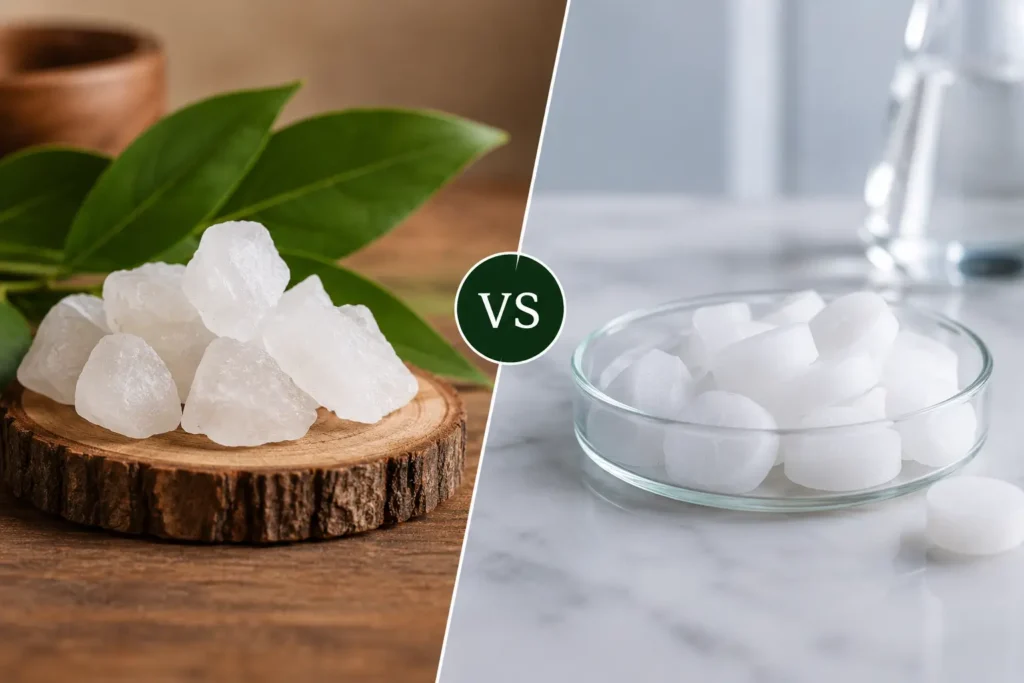
Walk into any pooja supplies shop or pharmacy and you’ll find camphor labelled in a confusing mix of ways – “natural,” “pure,” “Bhimseni,” “synthetic,” “edible.” For something used daily in millions of Indian households for aarti, havan, and home remedies, there’s surprisingly little clarity on what these terms actually mean, and which one is genuinely safer.
This guide breaks down the real chemistry behind natural and synthetic camphor, what actually determines safety and quality, and how to choose the right product for religious or medicinal use.
What Is Camphor, Chemically?
Camphor is a waxy, white crystalline compound with a strong, distinctive aroma. Regardless of its source, “camphor” refers to the same chemical compound. What differs is how it’s produced:
- Natural camphor is obtained by steam-distilling the wood, bark, and leaves of the camphor laurel tree (Cinnamomum camphora), a process used for centuries, particularly in East Asia.
- Pine-derived (industrially synthesized) camphor is manufactured by chemically converting turpentine – itself extracted from pine trees – through a multi-step synthesis process. This is how the vast majority of commercially available camphor, including most camphor powder sold in India today, is actually produced, even when marketed simply as “camphor” or “pure camphor.”
An important nuance: natural camphor extracted from the camphor tree is optically active (it rotates polarized light in one direction), while camphor produced through full chemical synthesis is typically a racemic mixture of both optical forms. In practical terms, both are the same core molecule and behave almost identically in most applications, though purists in traditional and religious use sometimes prefer tree-extracted camphor specifically for this reason.
Why “Natural vs Synthetic” Isn’t the Real Safety Question
Here’s the point that gets lost in marketing: purity and manufacturing quality matter far more for safety than whether the camphor originated from a tree or a pine-turpentine synthesis process. Both natural and pine-derived camphor are the same compound, and both can be produced to a high standard – or cut with fillers, paraffin, or lower-grade material to reduce cost.
The real safety and quality questions to ask are:
- Is the camphor free from adulterants and fillers?
- Does it meet a recognized purity standard (in India, this is governed by BIS IS 840 for camphor)?
- Does it burn cleanly, without leaving soot or synthetic-smelling residue?
- Is it manufactured and packaged under proper quality control, or sourced from an unverified bulk supplier?
A low-quality “natural” camphor tablet cut with wax fillers can be less safe and less effective than a high-purity, well-manufactured pine-derived camphor product – and vice versa. The label alone doesn’t tell you the quality.
Comparing Natural and Pine-Derived Camphor
| Factor | Natural (Tree-Extracted) Camphor | Pine-Derived (Synthesized) Camphor |
| Source | Cinnamomum camphora tree, steam-distilled | Turpentine from pine trees, chemically processed |
| Availability | Limited, more expensive | Widely available, cost-effective |
| Chemical structure | Optically active (single form) | Typically a racemic mixture |
| Common market presence | Premium/specialty products | Most commercial camphor powder, tablets, and blocks |
| Suitability for religious use | Traditionally preferred by purists | Widely and commonly used, including for pooja and havan |
| Suitability for medicinal/topical use | Used in some traditional formulations | Standard input for most pharmaceutical and topical products |
| Key safety factor | Purity and absence of adulterants | Purity, manufacturing standard, and BIS/IP compliance |
Safety Considerations for Both Types
Camphor, from either source, is a potent compound that should be used correctly regardless of label:
- For religious use (aarti, havan): high-purity camphor burns cleanly with minimal soot. Adulterated or low-grade camphor tends to leave black residue and can produce a harsher smell.
- For topical/medicinal use (balms, ointments): camphor is typically used in regulated concentrations within finished products. It should never be applied to broken or irritated skin, and concentrated or undiluted camphor is not intended for direct skin application.
- Ingestion risk applies to both types. Camphor is toxic if ingested in significant quantities, and should always be kept well out of reach of children, regardless of whether it’s labeled natural or synthetic. If accidental ingestion is suspected, seek medical attention immediately rather than waiting to see symptoms.
- For pharmaceutical or formulation use, work with a manufacturer that can supply Indian Pharmacopoeia (IP) grade material with proper documentation, rather than relying on unverified bulk camphor.
If you’re formulating a medicinal or topical product, consult a qualified formulation chemist or medical professional on appropriate concentrations – this article is intended as general product information, not medical guidance.
How to Choose Quality Camphor, Regardless of Label
- Ask for purity specifications, not just a “natural” or “pure” claim on the packaging.
- Check for burn quality – genuine, well-processed camphor should burn with minimal soot or residue.
- Look for recognized standards – BIS IS 840 compliance is a meaningful quality signal in the Indian market, as are IP-grade certifications for pharmaceutical buyers.
- Buy from manufacturers who explain their process, rather than unbranded bulk suppliers who don’t disclose sourcing or production methods.
- For bulk or export orders, ask about documentation such as MSDS, REACH compliance, and FSSAI certification where relevant to your use case.
SVD PineChem’s Camphor Products
SVD PineChem Private Limited has manufactured pine-derived camphor products since the 1960s. Our Camphor Powder is manufactured through the synthesis of high-quality turpentine sourced from pine trees, processed to deliver consistent purity for religious, medicinal, and industrial use. We also manufacture Bhimseni Camphor Flakes (Isoborneol Flakes), valued specifically for clean, low-residue burning in pujas and aartis, and Isoborneol Powder for fragrance, pharmaceutical, and industrial formulation use.
If you’re sourcing camphor for religious products, Ayurvedic formulations, or pharmaceutical applications and want documented purity and consistent supply, get in touch with our team for specifications and samples.
Frequently Asked Questions
Is natural camphor better than synthetic camphor for pooja?
Both can be used effectively for religious ceremonies. What matters most is purity – high-quality camphor of either origin burns cleanly, while adulterated or low-grade camphor (natural or synthetic) tends to leave soot and residue.
Is synthetic camphor safe to use at home?
Yes, when it’s manufactured to proper purity standards. Most commercially available camphor in India, including camphor used in religious and household products, is produced through pine-turpentine synthesis rather than tree extraction, and is safe for its intended use when sourced from a reputable manufacturer.
Can camphor be ingested for medicinal purposes?
No. Camphor is intended for topical or inhalation use in regulated formulations, not for direct ingestion. It can be toxic in significant quantities. Always consult a healthcare professional before using camphor-based products medicinally.
What does BIS IS 840 mean for camphor quality?
It’s the Indian Standard specification for camphor, covering purity and quality parameters. Products that meet this standard offer buyers a documented quality benchmark rather than relying on unverified purity claims.
Is Bhimseni Kapoor the same as a regular camphor?
Bhimseni Kapoor (Bhimseni Camphor Flakes) is technically Isoborneol in flake form – a related but distinct compound valued for its clean burn and strong fragrance, commonly used alongside or instead of regular camphor in religious settings.
Sourcing high-purity camphor for religious, medicinal, or industrial use? Contact SVD PineChem for specifications, certifications, and bulk pricing.
