

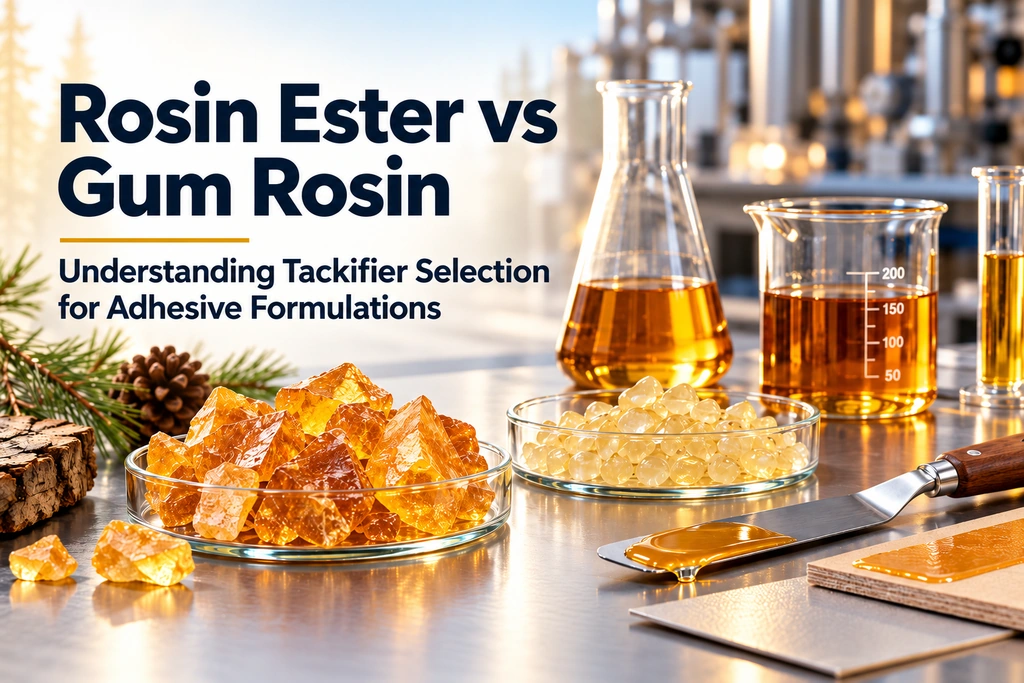
Tackifiers help adhesive formulations develop the tack, adhesion and application behaviour required for a particular product. Rosin-based materials are widely used in adhesive chemistry, and buyers often weigh rosin ester vs gum rosin when selecting a resin component. These materials are related but not interchangeable in every formulation. Gum rosin is a natural resin mixture, while rosin ester is produced by chemically reacting rosin acids with suitable alcohols. That modification changes important properties, so formulators should select materials based on compatibility, performance targets and processing conditions.
What is gum rosin?
Gum rosin is the non-volatile resin fraction obtained from pine oleoresin. It contains a mixture of resin acids and is supplied in solid form. Its properties depend on source and processing, and industrial specifications may include colour, acid value, softening point and other parameters. It can be used as a raw material in adhesive formulations or as a feedstock for further chemical modification, depending on the adhesive system and the required balance of tack, compatibility and stability.
What is rosin ester?
Rosin ester is produced by esterifying rosin acids with an appropriate alcohol. This reaction modifies the chemical functionality of the rosin and can change properties of rosin and its esters such as softening point, compatibility, colour, odour and stability. Rosin ester describes a family of products rather than one universal material, so buyers should identify the ester type, grade and specification relevant to the application.
Rosin ester vs gum rosin: key differences
| Comparison | Gum rosin | Rosin ester |
|---|---|---|
| Material type | Natural resin mixture containing resin acids. | Chemically modified rosin derivative produced through esterification. |
| Chemical functionality | Contains free resin acid groups. | A portion of acid functionality is converted to ester groups, depending on grade. |
| Softening behaviour | Depends on source and grade; specified by supplier. | Can be tailored through ester type and manufacturing process. |
| Compatibility | Must be evaluated with polymer and formulation components. | Often selected for a particular compatibility profile; still requires testing. |
| Formulation role | Can be used directly or as feedstock for derivatives. | Commonly used as a tackifier resin in suitable adhesive systems. |
| Selection basis | Raw-material properties, acid value, colour and formulation response. | Ester type, softening point, compatibility, colour and adhesive performance. |
Why tackifier selection matters for rosin ester vs gum rosin
A tackifier can influence initial tack, peel adhesion, cohesion, wetting, viscosity and processing behaviour. The effect depends on the base polymer, plasticizer, wax, oil, other resins and ingredient ratios, so a resin that performs well in one adhesive system may not suit another. Selection should begin with target adhesive properties and the polymer system, not simply with a comparison of resin prices.
Rosin ester vs gum rosin in hot-melt adhesives
Hot-melt adhesives are applied in a molten state and set as they cool. Tackifier selection can influence melt viscosity, open time, setting behaviour, wetting and adhesion to the substrate. Evaluate compatibility with the base polymer and the full formulation over the intended processing-temperature range, check softening point, thermal stability, colour and viscosity behaviour as relevant, and run trials using actual equipment and substrates where possible.
Rosin ester vs gum rosin in pressure-sensitive adhesives
Pressure-sensitive adhesives need a balance between tack, peel adhesion and shear or holding power, and tackifier choice can shift that balance depending on the polymer and other ingredients. Compatibility and phase stability are important, particularly when the product must remain consistent during storage and use. Test the complete formulation using methods appropriate to the intended tape, label or other application, and do not infer final adhesive performance from a single raw-material parameter.
How to choose between rosin ester vs gum rosin
- Define the adhesive category and the role of the tackifier.
- Identify the base polymer and compatibility requirements.
- Set target windows for tack, peel, cohesion, viscosity and colour as applicable.
- Compare gum rosin or rosin ester grades using current technical data sheets.
- Check softening point, acid value or ester-related parameters relevant to the grade.
- Run controlled formulation trials and evaluate on intended substrates.
- Document the approved material, specification and change-control requirements.
Specifications and tests to review for rosin ester vs gum rosin
| Parameter | Why it may matter |
|---|---|
| Softening point | Can influence processing temperature, viscosity and adhesive behaviour. |
| Colour | Important where the finished adhesive or coating has a colour requirement. |
| Acid value | Relevant to gum rosin and certain derivatives; interpret against grade. |
| Compatibility | Helps determine whether the resin blends appropriately with the polymer system. |
| Viscosity / melt behaviour | Important for processing and application, depending on product. |
| Thermal stability | May influence colour and performance during processing or service. |
| Batch consistency | Supports repeatable formulation and manufacturing. |
Common mistakes when comparing rosin ester vs gum rosin
- Assuming all rosin esters have the same properties.
- Replacing gum rosin with rosin ester without compatibility testing.
- Choosing a tackifier only by softening point or price.
- Ignoring the base polymer and other formulation ingredients.
- Testing only a laboratory blend rather than relevant application conditions.
- Failing to define batch variation and documentation.
Questions for a tackifier supplier
- What exact rosin ester type and grade is offered?
- Can you provide the current technical data sheet and SDS?
- What are typical and guaranteed specification limits?
- What compatibility information is available for the intended polymer system?
- Can you provide a sample for laboratory and application testing?
- How are batches identified and test results documented?
SVD PineChem: rosin-based raw materials
SVD PineChem supplies gum rosin, also known as colophony, as part of its pine chemicals range, alongside pine terpenes. If your formulation calls for a rosin derivative, confirm the specific grade and availability with the team before planning trials, and request the current technical data sheet, SDS and batch documentation. You can also browse the full product portfolio.
Choosing Between Rosin Ester vs Gum Rosin? Get Specification Support First
Gum rosin and rosin ester are related materials, but esterification changes properties that matter in adhesive formulation. Select a tackifier by considering the base polymer, target performance, compatibility and processing conditions, and review technical data and test the complete formulation to avoid costly assumptions.
Need gum rosin for your adhesive formulation, or unsure which rosin-based material fits? Share your application, base polymer and target specification with our team and get the technical documents and sample support you need before you order. Contact SVD PineChem today, or explore our gum rosin range from SVD PineChem.
FAQs
What is the main difference between rosin ester vs gum rosin?
Gum rosin is a natural resin mixture containing resin acids. Rosin ester is produced by reacting rosin acids with suitable alcohols, changing its properties.
Is rosin ester a tackifier?
Many rosin ester grades are used as tackifier resins in suitable adhesive formulations. The right grade depends on the polymer and performance requirements.
Can gum rosin be used in hot-melt adhesives?
It may be used in certain formulations, but suitability depends on the base polymer, formulation and performance targets.
Is rosin ester always better?
No. The best choice depends on formulation, process and end-use requirements.
What should I test when selecting a tackifier?
Depending on the application, evaluate compatibility, tack, peel adhesion, cohesion, viscosity, colour and thermal behaviour.
Can I replace gum rosin with rosin ester directly?
Do not assume direct substitution will work. Reformulation and controlled testing are recommended.
