

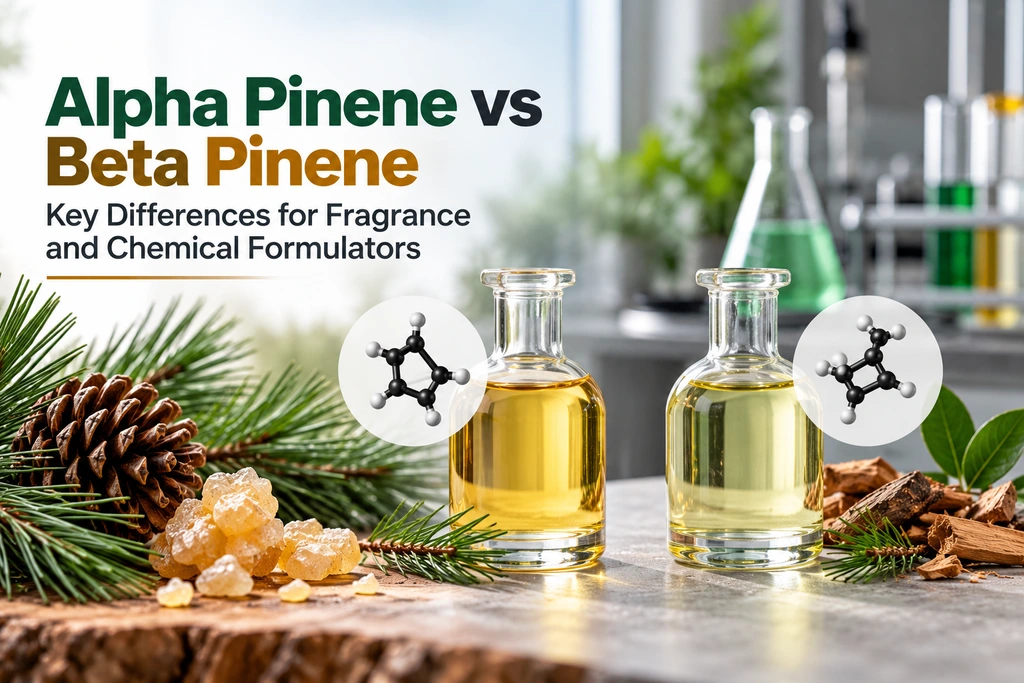
Alpha pinene vs beta pinene is one of the most common comparisons for buyers of pine chemicals. Both are naturally occurring monoterpene hydrocarbons associated with pine and other plant-derived materials, and both are used in fragrance-related applications and as feedstocks for chemical processes. They share the molecular formula C10H16 but are structurally distinct compounds. For formulators and procurement teams, understanding those differences helps with material identification, specification review and application selection.
What are alpha pinene and beta pinene?
They are structural isomers of pinene: the same molecular formula, but a different arrangement of atoms and a different position of the carbon-carbon double bond within their bicyclic terpene structures. Both may be present in turpentine streams, with relative composition depending on botanical source, feedstock and processing.
Commercial descriptions should make clear whether the product is alpha pinene, beta pinene, a defined blend or a turpentine fraction containing multiple terpene compounds.
Alpha pinene vs beta pinene: key differences
| Comparison | Alpha pinene | Beta pinene |
|---|---|---|
| Chemical identity | Monoterpene hydrocarbon; structural isomer of beta pinene. | Monoterpene hydrocarbon; structural isomer of alpha pinene. |
| Molecular formula | C10H16 | C10H16 |
| Structure | Bicyclic terpene with the double bond inside the ring. | Bicyclic terpene with an exocyclic double bond (methylene group). |
| Odour profile | Often described as fresh, pine-like and woody; depends on purity and mixture. | Often described as pine-like, woody or resinous; depends on purity and mixture. |
| Industrial relevance | Used in fragrance compositions and as a chemical feedstock or intermediate. | Used in fragrance-related applications and selected chemical transformations. |
| Procurement focus | Confirm isomer identity, assay, impurities and physical properties. | Confirm isomer identity, assay, impurities and physical properties. |
Why molecular structure matters in alpha pinene vs beta pinene
A change in molecular structure can influence odour character, reactivity and suitability for downstream processes. Although the two share a molecular formula, they should not be assumed interchangeable in every recipe or chemical reaction. The correct choice depends on the target molecule or fragrance profile, required purity, process conditions and end-product specifications. Where performance is sensitive, run controlled trials using the exact commercial grade being considered.
Common applications of alpha pinene vs beta pinene
Alpha pinene
Alpha pinene is used in fragrance compositions for its characteristic pine-like note and as a starting material in chemical transformations. Depending on grade and process, it may be used to produce fragrance ingredients and other terpene-derived chemicals.
Beta pinene
Beta pinene is also used in fragrance-related applications and as a chemical feedstock. It can be relevant to the manufacture of selected terpene derivatives and specialty chemicals. Suitability depends on the target process and material specification.
What to check when sourcing alpha pinene vs beta pinene
| Specification | What to review |
|---|---|
| Isomer identity | Confirm alpha pinene, beta pinene or a mixture. |
| Assay / purity | Check declared content and analytical method. |
| Isomer and impurity profile | Review other terpene components that may affect odour or process performance. |
| Physical properties | Compare density, refractive index, boiling range and other relevant parameters. |
| Stability and storage | Review oxidation precautions and recommended storage conditions. |
| Safety documentation | Obtain current SDS and follow handling and transport requirements. |
| Batch traceability | Confirm batch identification and certificate of analysis availability. |
How to choose between alpha pinene vs beta pinene
- Define the intended application: fragrance formulation, chemical synthesis or another industrial process.
- Identify the exact isomer required by the formulation or process specification.
- Set acceptable limits for assay, related terpenes and impurities.
- Review the supplier’s technical data sheet and Safety Data Sheet.
- Evaluate a representative sample under actual process conditions.
- Record the approved grade and batch requirements in the purchasing specification.
Why feedstock consistency matters for alpha pinene vs beta pinene
Terpene composition can vary with botanical source, season, collection practices and processing. For buyers using pinene as a feedstock, variation may influence reaction behaviour, yield, odour or downstream purification. Discuss product origin where relevant, refining route, batch testing and change-control practices, and avoid relying on a broad description such as “pine terpene” when the process requires a specific isomer.
Storage and handling
Pinene products are combustible organic chemicals. Handle them according to the current product-specific Safety Data Sheet and applicable workplace procedures. Keep containers closed, use suitable ventilation and ignition controls, and follow the supplier’s requirements for storage, incompatible materials, spill response and personal protective equipment.
SVD PineChem pine terpene compounds
SVD PineChem’s pine terpenes range includes alpha pinene and beta pinene alongside gum turpentine, distilled turpentine oil, dipentene, pine oil, terpineol and delta-3-carene. Share your application and required isomer with the team, and request the current grade details, technical data sheet, SDS and certificate of analysis before approving a sample. You can also browse the full product portfolio or learn who we are.
Choosing Between Alpha Pinene vs Beta Pinene? Get the Right Grade Confirmed
Alpha pinene and beta pinene belong to the same terpene family, but their structural differences can matter to fragrance character and chemical processing. Confirm the exact isomer, assay and impurity profile before purchasing, and support consistent results with a well-defined specification and sample evaluation.
Not sure whether alpha pinene or beta pinene suits your formulation or process? Share your application, required isomer and purity range with our team and get the right grade, documentation and sample support. Contact SVD PineChem today, or explore our pine terpene range from SVD PineChem.
FAQs
Alpha pinene vs beta pinene: are they the same chemical?
No. They are structural isomers with the same molecular formula, C10H16, but different molecular structures.
Do they have the same smell?
Both are associated with pine-like odour profiles, but aroma characteristics can differ. Purity and mixtures also affect perception.
What are common alpha pinene uses?
Depending on grade and process, it is used in fragrance compositions and as a feedstock for selected terpene-derived chemicals.
What are beta pinene applications?
It is used in fragrance-related applications and as a feedstock for certain chemical transformations.
Can alpha pinene replace beta pinene?
Not automatically. Confirm the formulation requirement and conduct trials because their structures and reactivity differ.
What documents should I request when comparing alpha pinene vs beta pinene?
Request a technical data sheet, current SDS and batch-specific certificate of analysis where available.
