

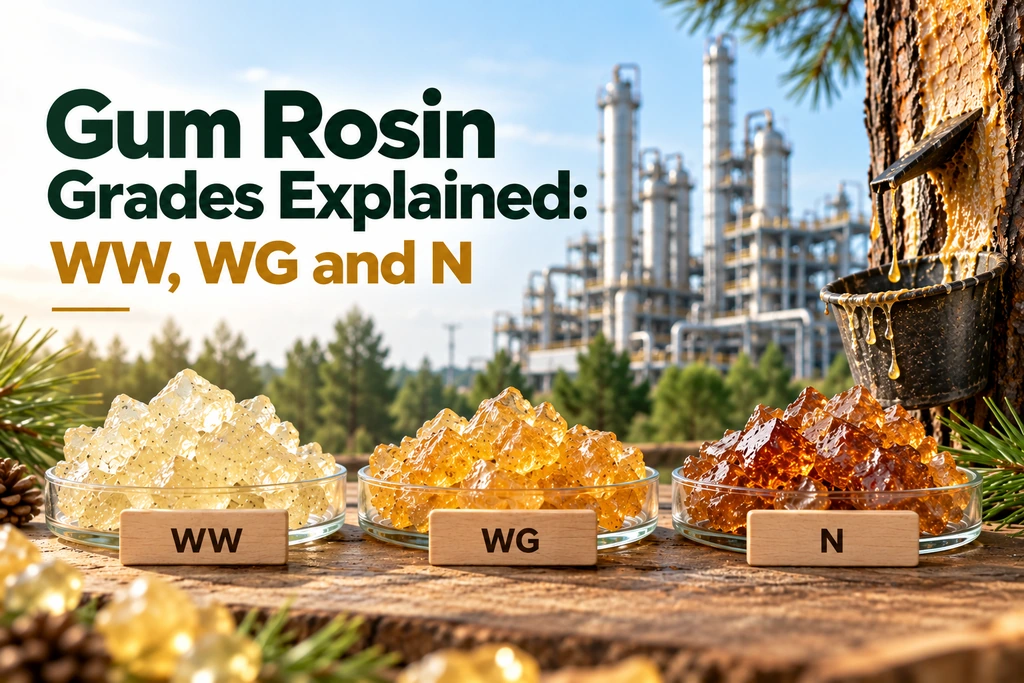
Gum rosin is a natural resin used in adhesives, printing inks, coatings, rubber compounds and paper-related applications. When buyers compare suppliers, they usually start with gum rosin grades labels such as WW, WG and N. These designations are useful, but they describe only one thing: the colour classification of the resin.
For industrial procurement, the right grade is the one that meets the formulation’s full technical requirements. A lighter colour does not automatically mean better adhesion, tack or processing behaviour. This guide explains what the grades mean, which specifications matter beyond colour, and how to choose with confidence. For the full range, see our gum rosin page.
What Is Gum Rosin?
Gum rosin is obtained by processing oleoresin collected from pine trees. Processing separates the volatile turpentine from the non-volatile resin fraction. The resulting rosin is generally a brittle solid at ambient conditions. Its characteristics can vary with pine species, collection conditions, processing and storage. You can read more about its chemistry and history in this overview of rosin.
A purchase specification should name the grade and the physical and chemical parameters that matter for the intended application. The trade name alone is not a complete quality description.
What Do WW, WG and N Grades Mean?
WW, WG and N are designations from the traditional rosin colour grading scale. Broadly, WW is lighter than WG, and N is a darker colour range. Exact boundaries depend on the grading standard and test method, so ask your supplier which standard they use and request the relevant specification.
| Grade | General colour description | Buyer consideration |
|---|---|---|
| WW | Very pale, or water-white, range in common terminology | Consider where light colour is important; verify the test method and full specification |
| WG | Generally darker than WW | May suit applications that permit a deeper colour; compare the technical data |
| N | A darker grade in traditional classifications | Confirm that colour and all other parameters meet the formulation requirement |
Why Colour Grade Matters
Colour can influence the appearance of finished adhesives, coatings and inks, particularly in lighter or translucent systems. Choosing an appropriate grade helps maintain a target shade. However, colour does not directly measure tack, adhesion, compatibility, thermal stability or overall performance.
Two batches with the same colour grade may differ in other properties, so avoid selecting material on colour alone.
Gum Rosin Specifications to Review Beyond Colour
| Parameter | Why it matters |
|---|---|
| Colour / colour grade | Helps manage raw-material and finished-product appearance; confirm the method |
| Acid value | A key characteristic describing rosin chemistry and batch consistency |
| Softening point | Indicates thermal behaviour and can affect processing |
| Ash content | Indicates inorganic residue; limits depend on the application |
| Insoluble matter | May affect filtration, processing cleanliness and product quality |
| Moisture / volatile content | Can influence handling and processing consistency |
| Packaging and storage | Protects the resin from contamination and unsuitable conditions |
How to Select a Gum Rosin Grades for Adhesives
Adhesive systems have different requirements. A hot-melt adhesive, a pressure-sensitive adhesive and a rubber-based adhesive may each use rosin in a different way. Start with the base polymer and the role the rosin plays in the formulation.
- Identify the adhesive type and the function of gum rosin in the formulation.
- Define critical properties such as colour, acid value, softening point and compatibility.
- Confirm the supplier’s colour grading standard and analytical methods.
- Request a representative sample and evaluate it in your actual formulation.
- Compare processing behaviour and finished-product performance, not just appearance.
- Approve a written specification with agreed limits and batch documentation.
Common Gum Rosin Sourcing Mistakes
- Assuming WW is always superior to WG or N
- Comparing grade labels without confirming the test method
- Ignoring acid value, softening point or other application-critical parameters
- Choosing solely on price without formulation trials
- Failing to agree batch tolerances and documentation
- Overlooking packaging and storage conditions
Questions to Ask Your Gum Rosin Supplier
- Which grading standard and colour test method do you use?
- Can you provide a current technical data sheet?
- Are batch-specific test results available?
- What are the typical values and the guaranteed limits?
- How is the product packed and stored?
- Can a sample be supplied before a bulk order?
Sourcing Gum Rosin from SVD PineChem
SVD PineChem is one of the pioneers of the Indian pine chemicals industry, with roots dating back to the early 1960s. We source, manufacture and distribute pine chemicals for Indian and overseas customers, supported by our manufacturing facilities at Vashi and an in-house R&D lab that keeps quality consistent across our range.
When you enquire about gum rosin, tell us your application, target colour and the parameters that matter most to your formulation. We can then guide you on suitable options, documentation and samples. To discuss your requirement, contact our team.
Choosing the Right Gum Rosin Grades
WW, WG and N are a useful starting point for understanding gum rosin colour, but a sound purchase rests on the full specification. Before you buy:
- Confirm the grading standard and colour test method.
- Compare acid value, softening point and the other parameters your application needs.
- Test a sample in your own formulation.
- Agree written specifications and batch documentation with your supplier.
A clear specification and a proper sample trial give you more consistent sourcing than a grade label alone. To explore more options, browse our full product range.
Frequently Asked Questions
What is WW grade gum rosin?
WW is a commonly used light-colour grade designation. Its exact colour range depends on the standard and test method.
What is the difference between WW and WG gum rosin?
WW is generally lighter than WG in common grading terminology. Compare the supplier’s stated method and the full specification.
Is N grade rosin lower quality?
Not necessarily. N is a darker colour grade. Suitability depends on the application and its colour and performance requirements.
Which gum rosin grade is best for adhesives?
There is no universal best grade. The choice depends on adhesive chemistry, target colour, compatibility and performance.
Does lighter rosin always perform better?
No. Colour grade does not independently predict tack, adhesion or thermal performance.
What documents should I request from a rosin supplier?
Request a technical data sheet and, where available, batch-specific test documentation.
