

Let’s be honest—when you think about the raw materials running your business, “pine tree sap” might not be the first thing that pops into your head. But if you look closely at the everyday products around you, from the glossy paint on your walls to the glue on your packing tape, you are likely looking at the magic of Gum Rosin.
If you are a manufacturer, a trader in the chemical market, or even someone running an MSME (Micro, Small, and Medium Enterprise) in India, you already know that sourcing the right raw materials is half the battle won. We often rely on quick jugaad or local suppliers to get things moving, but when it comes to standardizing your final product, you need to understand exactly what you are working with.
So, let’s take a deep dive into the world of Gum Rosin. We will explore its practical uses, everyday benefits, what the Indian market looks like right now, and exactly what you should look for before making your next bulk purchase.
What Exactly is Gum Rosin?
In the simplest terms, Gum Rosin is a solid form of resin obtained from pine trees. When pine trees are tapped (similar to how rubber is harvested), they release a sticky sap. Once this sap is heated to vaporize the volatile liquid components (like turpentine), what you are left with is a hard, brittle, translucent substance—that’s your rosin.
Depending on how it is processed and the specific species of the pine tree, it can range in color from a pale, clear yellow to a dark, opaque brown.
The Core Uses and Benefits: Why You Need It
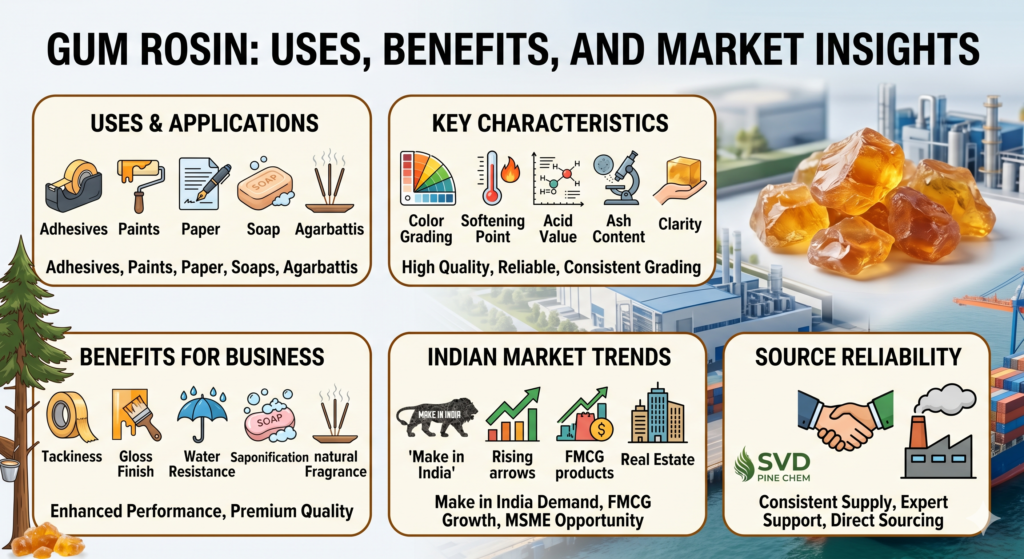
The versatility of Gum Rosin is genuinely remarkable. It is the silent workhorse behind numerous industries. Here is a look at where it shines the brightest:
- Adhesives and Sealants: This is perhaps its biggest claim to fame. Gum Rosin acts as an excellent “tackifier.” If you are manufacturing pressure-sensitive adhesives, hot-melt glues, or even the sticky backing of standard office tape, adding rosin gives your product that essential, immediate grip.
- Paints, Inks, and Coatings: Have you ever noticed how high-quality paints have a brilliant, glossy finish and dry quickly? That is often thanks to rosin-based resins. It is also heavily used in printing inks, ensuring the ink binds perfectly to paper or plastic packaging.
- Paper Manufacturing: If paper didn’t have a “sizing” agent, every time you wrote on it with a pen, the ink would bleed and spread out like a watercolor painting. Rosin is used to coat paper fibers, making them water-resistant and ensuring crisp, clean printing.
- Soap and Cosmetics: In the Indian FMCG sector, certain grades of rosin are saponified (turned into soap) to create laundry soaps that lather up beautifully, even in hard water conditions.
- Agarbattis and Puja Materials: In a uniquely Indian context, raw pine resins are frequently used in the manufacturing of dhoop, agarbattis (incense sticks), and havan samagri. It acts as a natural binder and releases a pleasant, earthy, pine fragrance when burned.
Practical Concerns When Using Gum Rosin
Working with Gum Rosin isn’t entirely foolproof. If you are handling it on your factory floor, there are a few practical, everyday headaches you might run into.
First, it is highly sensitive to oxidation. If you leave it exposed to the open air and intense Indian summer heat for too long, it will darken in color and lose its tackiness, which can ruin a batch of light-colored adhesives or paints. Second, it is quite brittle. During transport over bumpy roads, large chunks can easily crush into fine dust, which changes how it melts and mixes into your formulas. Always ensure your storage area is cool, dry, and well-ventilated to protect your inventory.
6 Key Features to Look For in High-Quality Gum Rosin
When you are negotiating with a supplier, you cannot just accept any yellowish rock they hand you. To ensure your final product is top-tier, here are 6 non-negotiable features you need to check:
- 1. The Right Color Grade: Gum Rosin is graded alphabetically by color (from dark to light). The most popular high-quality grades in India are “WW” (Water White) and “WG” (Window Glass). If you are making transparent glues or light paints, always demand WW or WG grades.
- 2. Optimal Softening Point: This indicates the exact temperature at which the hard rosin starts to become soft and fluid. A good quality rosin typically has a softening point between 72°C and 78°C. If it’s too low, your product might melt during transit in hot weather!
- 3. High Acid Value: The acid value determines how well the rosin will react with other chemicals (like when making soaps or synthetic resins). Look for an acid value of 160 mg KOH/g or higher for optimal chemical reactivity.
- 4. Minimal Ash Content: You don’t want to pay for dirt. High-quality rosin should have an ash content of less than 0.04%. Anything higher means impurities like tree bark or soil made it into the final batch.
- 5. Clarity and Transparency: Hold a chunk of the rosin up to the light. It should be relatively clear and translucent. Cloudy or highly opaque rosin usually indicates trapped moisture or poor processing.
- 6. Sturdy Packaging: Because it is prone to oxidation and physical damage, check how it is packed. It should ideally come in tightly sealed galvanized iron (GI) drums or heavy-duty multi-layer paper bags with a plastic liner to keep moisture out.
Crucial Safety Reminder for Your Workspace
While Gum Rosin is a natural product, it demands respect on the factory floor.
- Fire Hazard: Rosin dust is highly flammable. Keep it far away from open flames, sparks, and high-heat areas to prevent flash fires.
- Respiratory Protection: When rosin is heated (especially during soldering or hot-melt mixing), it releases fumes that can cause “colophony asthma.” Always ensure your workers are wearing proper N95 masks and that your facility has heavy-duty exhaust fans.
- Skin Sensitization: Prolonged handling of raw rosin can cause allergic contact dermatitis in some people. Provide your staff with protective gloves.
Market Insights and The Road Ahead
The market for Gum Rosin in India is currently on an impressive upward swing. Thanks to the “Make in India” initiative, domestic manufacturing of paints, tires, and packaging materials is booming. Consequently, the demand for high-quality, reliable raw materials is higher than ever. Prices can fluctuate based on global pine resin harvests and monsoon patterns, but the long-term trajectory points to steady growth.
To navigate this busy market and ensure your production lines never halt, the most brilliant move you can make is partnering with a supplier who understands your specific needs. You want a vendor who guarantees consistent grading, proper packaging, and reliable delivery. By sourcing your materials through trusted industry experts like SVD Pine Chem, you can stop worrying about the quality of your raw inputs and focus entirely on what you do best—scaling your business and building better products.
