

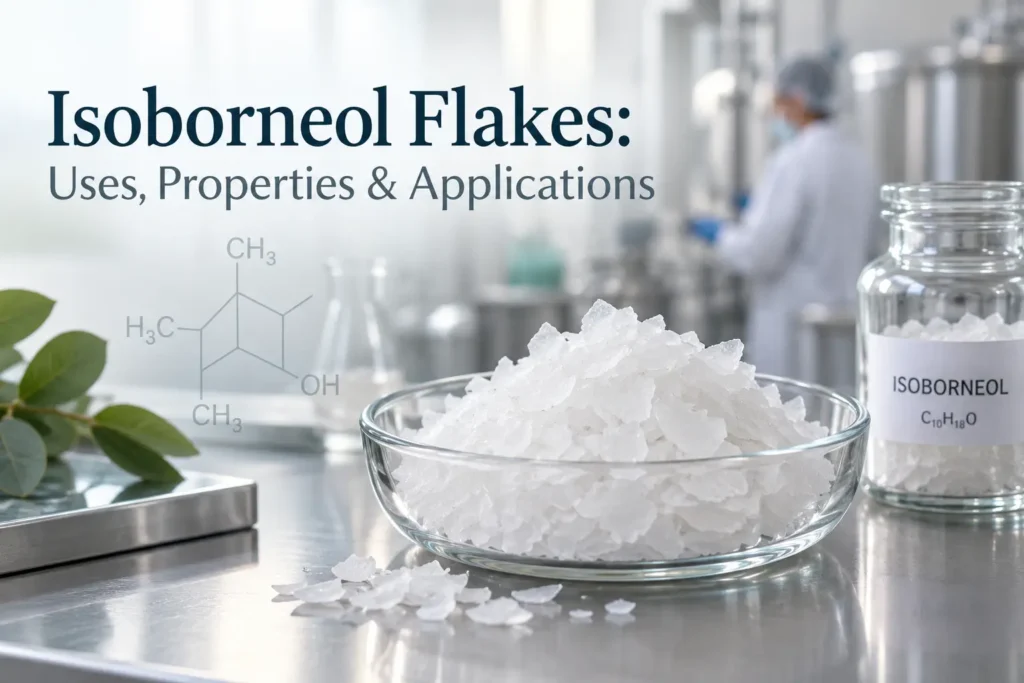
Isoborneol is one of those pine-chemical derivatives that quietly shows up across a surprisingly wide range of industries – from the incense stick burning in a temple to the pain-relief balm in a medicine cabinet. In its flake form, it’s better known to most people as Bhimseni Kapoor or Bhimseni Camphor Flakes, but the underlying compound and its properties are the same as what drives dozens of industrial and consumer applications.
This guide breaks down what Isoborneol Flakes actually are, their key properties, and where they’re used across fragrance, pharmaceutical, religious, and industrial sectors.
What Are Isoborneol Flakes?
Isoborneol is a white crystalline compound manufactured through the synthesis of turpentine obtained from pine trees. Depending on how it’s processed and sold, it takes two common commercial forms:
- Isoborneol Powder – a fine, white crystalline powder, commonly used as a raw material input for fragrance, pharmaceutical, and industrial formulations
- Isoborneol Flakes (commercially known as Bhimseni Camphor Flakes or Bhimseni Kapoor) – the same compound processed into white to transparent flakes, primarily used for religious, aromatherapy, and direct-burning applications
Both forms share the same core chemical properties – a camphor-like aroma, a cooling sensation on skin contact, and clean, low-residue combustion – but the flake form is generally preferred where the end use involves burning (pujas, aartis, incense) or where a slower-dissolving format is useful in balms and topical formulations.
Key Properties of Isoborneol
- Camphoraceous aroma – a fresh, cooling, camphor-like scent that’s long-lasting and easily recognizable
- Clean, low-residue burning – unlike lower-grade synthetic camphor, quality isoborneol flakes burn without leaving noticeable soot
- Cooling sensation on skin – the basis for its widespread use in balms, ointments, and topical pain-relief products
- Antimicrobial and anti-inflammatory characteristics – commonly cited in traditional and Ayurvedic use for minor skin irritation and congestion relief
- Natural insect-deterrent properties – used in repellent formulations against mosquitoes and moths
Industrial and Commercial Uses of Isoborneol Flakes
1. Fragrances and Perfumery
Isoborneol’s fresh, camphor-forward scent profile makes it a common ingredient in perfumes, scented candles, and air fresheners, where its long-lasting character helps anchor a fragrance blend.
2. Incense and Religious Products
This is one of the largest use categories in India. Isoborneol flakes (as Bhimseni Kapoor) are widely used in incense sticks, cones, and directly in pujas and aartis, valued for their pure, residue-free burn and traditional significance in Hindu rituals.
3. Ayurvedic and Traditional Medicine
Isoborneol has a long history in Ayurvedic and traditional Chinese medicine formulations, particularly in balms, muscle-relief oils, and preparations used for cold and congestion relief.
4. Pharmaceuticals and Topical Skincare
Its anti-inflammatory and antimicrobial characteristics support its use in topical ointments, antiseptic creams, and pain-relief balms, typically in combination with other active ingredients.
5. Pesticides and Insect Repellents
Isoborneol’s natural insect-deterrent properties make it a useful component in repellent formulations aimed at mosquitoes, moths, and other household pests, often positioned as a more natural alternative to fully synthetic repellents.
6. Industrial and Specialty Chemical Applications
Beyond consumer products, isoborneol is used as an intermediate in the production of specialty chemicals, resins, and synthetic fragrance compounds.
7. Handmade Soaps and Herbal Formulations
Its cooling and antibacterial characteristics make it a popular addition to handmade soaps and herbal skincare products aimed at natural wellness positioning.
Isoborneol Flakes vs. Isoborneol Powder: Which Do You Need?
| Factor | Isoborneol Flakes (Bhimseni Kapoor) | Isoborneol Powder |
| Primary use | Direct burning – pujas, aartis, incense | Raw material input for formulations |
| Form | White to transparent flakes | Fine white crystalline powder |
| Best suited for | Religious/ritual use, aromatherapy | Fragrance, pharma, cosmetic, and industrial manufacturing |
| Dissolving rate | Slower, ideal for controlled burning | Blends easily into liquid/solid formulations |
If you’re manufacturing incense, pooja items, or aromatherapy products, flakes are typically the right format. If you’re formulating perfumes, balms, ointments, or industrial products where isoborneol is one input among several, powder form usually integrates more easily.
What to Look for When Sourcing Isoborneol Flakes
For businesses buying in bulk – whether for repackaging, incense manufacturing, or formulation – a few quality checks matter:
- Purity – ask for quality specifications rather than relying on general marketing claims
- Clean burn – request a sample and test for soot or residue before committing to a bulk order
- Consistent fragrance strength – batch-to-batch consistency matters for repeat customers who notice quality differences
- Manufacturer transparency – suppliers who manufacture their own Isoborneol Powder in-house generally have tighter control over the quality of the finished flakes than those repackaging bought-in material
Sourcing Isoborneol Flakes and Powder from SVD PineChem
SVD PineChem Private Limited (formerly SVD Resins & Plastics) has been part of India’s pine chemicals industry since the 1960s, manufacturing Isoborneol Powder and processing it further into Bhimseni Camphor Flakes for religious, aromatherapy, and wellness applications. Our in-house manufacturing – from pine terpene synthesis through to finished flakes – supports the purity and consistency that buyers need for both formulation inputs and direct-burning products.
We also manufacture related pine-chemical products including Camphor Powder, Gum Rosin, and Pine Terpenes.
For bulk quantities, specifications, or samples, contact our team.
Frequently Asked Questions
Are Isoborneol Flakes the same as Bhimseni Camphor?
Yes. Bhimseni Camphor Flakes (also called Bhimseni Kapoor) are Isoborneol processed into flake form, commonly used for religious and aromatherapy purposes.
Is Isoborneol safe to use on skin?
It’s used in balms, ointments, and skincare formulations for its cooling and soothing properties, but concentration and formulation matter. Product developers should follow appropriate usage guidelines and consult a formulation specialist for skincare or medicinal applications.
What is the main difference between Isoborneol Flakes and Isoborneol Powder? They’re the same base compound in different physical forms. Flakes are generally used for direct burning (pujas, incense), while powder is typically used as a raw material input in fragrance, pharmaceutical, and industrial formulations.
Can Isoborneol be used as a natural insect repellent?
Yes, its natural insect-deterrent properties make it a common ingredient in repellent formulations, often marketed as a more natural alternative to fully synthetic options.
Is Isoborneol derived from natural sources?
Isoborneol is manufactured through the synthesis of turpentine obtained from pine trees, making it a pine-derived compound rather than a purely synthetic, petroleum-based one.
Sourcing Isoborneol Flakes or Powder for your business? Get in touch with SVD PineChem for specifications, samples, and bulk pricing.
